The business of vaccines is soon to become a major source of profits for the world’s largest pharmaceutical corporations. A press release (Business Wire, January 21st 2016) published by marketwatch.com says that Technavio, one of the leading technology research and advisory companies in the world predicts that pharmaceutical corporations who produce vaccines will reach an estimated $61 billion in profits by 2020.
By Timothy Alexander Guzman
Today the vaccine market is worth close to $24 billion. The report titled ‘Global Human Vaccines Market 2016-2020’ gives an “in-depth analysis” of the possible revenues and “emerging market trends” globally. According to the Press Release:
The report study indicates that the introduction of new products is fueling the growth of the market. Moreover, the significant expansion of the current product offerings is also expected to boost the market growth. Due to the increasing prevalence rates of various infectious diseases such as diphtheria, influenza, hepatitis, pneumococcal diseases, and meningococcal diseases, there has been a notable increase in the use of vaccines across the globe
What is interesting about the report is that Pharmaceutical corporations are targeting Latin America and the Caribbean with its new vaccines soon to be on the market. Merck & Co, Pfizer and GlaxoSmithKline (GSK) are expected to dominate Latin America and the Caribbean (Puerto Rico currently operates as a manufacturing hub for Merck, Pfizer and Abbott Laboratories):
In terms of geography, the Americas dominated the global human vaccines market in 2015, accounting for about 45% of the total revenue. The US was the largest revenue contributor to this region in the same year, capturing a significant portion of the global market. The Americas will continue to dominate the human vaccines market during the forecast period because of the increase in the prevalence of infectious diseases and cancers. In addition, increase in strategic alliances with expected entry of novel vaccines, is also expected to propel the growth of the market in this region.
The report also says that there are two types of human vaccines, Therapeutic (cancer, metabolic disorders, chronic illnesses, and infectious diseases) and Preventable human vaccines markets (pediatric vaccinations) that are estimated to reach $55 billion worldwide. The Atlantic magazine published an article in 2015 titled ‘Vaccines Are Profitable, So What?’ Author Bourree Lam says:
While the main fixation of anti-vaccine groups is an old, discredited study linking vaccination to autism, another is a conspiracy theory circulated online that both doctors and pharmaceutical companies stand to profit financially from vaccination—which supposedly leads to perverse incentives in advocating for the public to vaccinate.
But that argument is historically unfounded. Not only do pediatricians and doctors often lose money on vaccine administration, it wasn’t too long ago that the vaccine industry was struggling with slim profit margins and shortages. The Economist wrote that “for decades vaccines were a neglected corner of the drugs business, with old technology, little investment and abysmal profit margins. Many firms sold their vaccine divisions to concentrate on more profitable drugs”
Maybe it was true at some point in time that manufacturing vaccines were unprofitable, but in today’s world, it’s all profits. What motivated pharmaceutical corporations to focus on the vaccine market in the last decade or so according to The Atlantic?
Since 2000, the Gavi Alliance has provided vaccination for 500 million children in poor countries, preventing an estimated 7 million deaths. GlaxoSmithKline reported that 80 percent of the vaccine doses they manufactured in 2013 went to developing countries. Additionally, vaccines that could turn a profit in high-income countries—constituting 82 percent of global vaccine sales in terms of value, according to the World Health Organization—hit the market
Lam also wrote that there were “two “blockbuster” vaccines also hit the market: pneumococcal conjugate for meningitis and other bacteria infections, and a vaccine for human papillomavirus (HPV). The industry grew”.
Merck is the only pharmaceutical giant licensed to produce and sell the measles vaccine called Prodquad and theMMR II (also used for the measles, mumps and rubella) and Varivax, a vaccine for the chicken pox. According to Lam, all three vaccines combined amounted to more than $1.4 billion in sales profits for Merck in 2014. The controversial HPV vaccine, Gardasil also brought in $1.7 billion in profits for Merck. “While a spokesperson for Merck told The Atlantic that vaccines remained one of its key areas of focus—it generated $5.3 billion in sales in 2014—she did not comment on the profit margins” Lam wrote. Of course the Merck spokesperson would not comment on the profitability of vaccines because Merck would expose itself to more controversy. Analysts say that the profit margin is“between 10 to over 40 percent.” Lam also says that “while the vaccine industry is likely more profitable now than in the 1970s or 1980s, this is the result of global market forces”. Lam forgot to mention that billionaire couple Bill and Melina Gates pledged at least $10 billion for worldwide vaccination programs supposedly to combat polio and the measles, this is where Merck & Co profit. It is also well known that Bill Gates appointed the former president and CEO of Merck, Raymond Gilmartin to the board of directors of Microsoft which lasted for more than 11 years before he announced his retirement in 2012.
Are pharmaceutical corporations motivated by profits? “Profits from vaccine production aren’t a valid argument against vaccinations—the most important question is whether vaccines are safe and effective, and the answer is unambiguously yes” wrote Lam. In 2015, Former Merck Employee and whistleblower Brandy Vaughan Spoke out against the state of California’s vaccination mandate bill SB277 and said:
The U.S. gives more vaccines than any other country in the world. Our childhood schedule for under the age of one has twice as many vaccines as other developed countries. What else do we have? The highest infant mortality rate of any developed nation. Finland has the lowest. They only give 11 by age six. Mississippi has the highest rate of vaccination in the U.S.–highest infant mortality rate. These numbers do not lie. But you will not hear that on the media, and that is not what Senator Pan will tell you.
What we have with vaccines is the highest profit margin pharmaceutical drug on the market. Drug companies make more money off vaccines than they do any other pharmaceutical drug, in terms of profit margin. There is a lack of rigorous safety studies. And they don’t have the incentive to do them because they have no liability.
Vaccines are the only products in the U.S. that do not have liability. You cannot sue for injuries or death. But that is only in the U.S. Around the world, there are law suits because of serious injuries and deaths because from vaccines. In Spain over Gardasil. In Japan over Gardasil. The flu shot was taken off the market for under five in Australia after deaths and injury. Prevnar was banned in China. Pfizer’s vaccination program was kicked out of the country. France just pulled Rotavirus off their schedule after infant deaths and injuries
With a forecast of $61 billion in projected sales, rest assured new vaccines will be developed for almost anything. Actor and comedian Jim Carrey did say that “150 people die every year from being hit by falling coconuts. Not to worry, drug makers are developing a vaccine”. With 271 vaccines in production, Jim Carrey’s comments, which were criticized by the mainstream media, may not be so far-fetched after all.
Oil. From farm to pharmaceutical, diesel truck to dinner plate, pipeline to plastic product, it is impossible to think of an area of our modern-day lives that is not effected by the petrochemical industry. The story of oil is the story of the modern world.
Parts of that story are well-known: Rockefeller and Standard Oil; the internal combustion engine and the transformation of global transport; the House of Saud and the oil wars in the Middle East.
Other parts are more obscure: the quest for oil and the outbreak of World War I; the petrochemical interests behind modern medicine; the Big Oil money behind the “Green Revolution” and the “Gene Revolution.”
But that story, properly told, begins somewhere unexpected. Not in Pennsylvania with the first commercial drilling operation and the first oil boom, but in the rural backwoods of early 19th century New York state. And it doesn’t start with crude oil or its derivatives, but a different product altogether: snake oil.
“Dr. Bill Livingston, Celebrated Cancer Specialist” was the very image of the traveling snake oil salesman. He was neither a doctor, nor a cancer specialist; his real name was not even Livingston. More to the point, the “Rock Oil” tonic he pawned was a useless mixture of laxative and petroleum and had no effect whatsoever on the cancer of the poor townsfolk he conned into buying it.
He lived the life of a vagabond, always on the run from the last group of people he had fooled, engaged in ever more outrageous deceptions to make sure that the past wouldn’t catch up with him. He abandoned his first wife and their six children to start a bigamous marriage in Canada at the same time as he fathered two more children by a third woman. He adopted the name “Livingston” after he was indicted for raping a girl in Cayuga in 1849.
When he wasn’t running away from them or disappearing for years at a time, he would teach his children the tricks of his treacherous trade. He once bragged of his parenting technique: “I cheat my boys every chance I get. I want to make ’em sharp.”
A towering man of over six feet and with natural good looks that he used to his advantage, he went by “Big Bill.” Others, less generously, called him “Devil Bill.” But his real name was William Avery Rockefeller, and it was his son, John D. Rockefeller, who would go on to found the Standard Oil monopoly and become the world’s first billionaire.
The world we live in today is the world created in “Devil” Bill’s image. It’s a world founded on treachery, deceit, and the naivety of a public that has never wised up to the parlor tricks that the Rockefellers and their ilk have been using to shape the world for the past century and a half.
This is the story of the oiligarchy.
PART ONE: BIRTH OF THE OIL-IGARCHY
Titusville, 1857. A most unlikely man alights from a railway car into the midst of this sleepy Western Pennsylvania town on the shores of Oil Creek: “Colonel” Edwin Drake. He’s from the Pennsylvania Rock Oil Company, and he’s here on a mission: to collect oil.
Like “Dr.” Bill, Drake isn’t really a Colonel. The title is bestowed on him by George Bissell and James Townsend, a lawyer and a banker who started the Pennsylvania Rock Oil Company after they discovered they could distill the region’s naturally occurring Seneca oil into lamp oil, or kerosene. Drake is actually an unemployed railroad conductor who talked himself into a job after staying at the same hotel as Bissel the year before. Calling him a Colonel, it is hoped, will help win the respect of the locals.
The locals think he’s crazy anyway. Seneca oil is indeed plentiful, bubbling out of seeps and collecting in the creek, but other than as a cure-all medicine or grease for the local sawmill’s machinery, it’s hardly seen as something valuable. In fact, it can be a downright nuisance, contaminating brine wells that supply Pittsburgh’s booming salt industry.
Still, Drake has a task to complete: finding a way to collect enough oil to make the distillation of Seneca oil into lamp oil profitable. He tries everything he can think of. The Native Americans had historically collected the oil by damming the creek near a seep and skimming the oil off the top. But Drake can only collect six to ten gallons of oil a day this way, even when he opens up extra seeps. He tries digging a shaft, but the groundwater floods in too quickly.
By the summer of 1859 he’s desperate. Drake’s running out of ideas, Bissell and Townsend are running out of patience and, most importantly, the company is running out of funds. He turns to “Uncle” Billy Smith, a Pittsburgh blacksmith who had experience drilling brine wells with steam-powered equipment. They get to work drilling down through the shale bedrock to reach the oil. It’s maddeningly slow work, with the crude equipment struggling to get through three feet of bedrock a day. By August 27th they’ve drilled down 69 and a half feet, Drake has used the last of his funds, and Bissell and his partners have decided to close up the operation. On August 28th, they strike oil.
Narrator: Then on Sunday, August 28th, 1859, oil bubbled up the drive pipe. Uncle Billy and his son Sam bailed out several buckets of oil. On Monday, the very day that Colonel Drake received his final payment and an order to close down the operation, they hitched the walking beam to a water pump and the oil began to flow. The first oil was to sell for $40 a barrel. Years later a local newspaper interviewed Uncle Billy about the day they struck oil:
“I commenced drilling and at 4:00 I struck the oil. I says to Mr. Drake, ‘Look there! What do you think of this?’ He looked down the pipe and said, ‘What’s that?’ And I said, ‘That is your fortune!'”
Drake’s well proved that by drilling for it, oil could be found in abundance and produced cheaply. Overnight a whole new industry was born. Before long in millions of homes, farms and factories around the world, lamps would be lit with kerosene refined from West Pennsylvania crude.
Daniel Yergin: When the word came out that Drake had struck oil, the cry went up throughout the narrow valleys of Western Pennsylvania: ‘The crazy Yankee has struck oil! The crazy Yankee has struck oil!’ And it was the first great boom. It was like a gold rush.
Overnight the quiet farming backwoods of rural Pennsylvania was transformed into a bustling oil region, with prospectors leasing up flats, towns springing up from nowhere, and a forest of percussion rigs covering the land. The first oil boom had arrived.
Already poised to make the most of this boom was a young up-and-coming bookkeeper in Cleveland with a head for numbers: John Davison Rockefeller. He had two ambitions in life: to make $100,000 and to live to 100 years old. John D. set off to make his fortune in the late 1850s, armed with a $1000 loan from his father, “Devil” Bill.
David Rockefeller: Grandfather never finished high school and went to Cleveland having borrowed $1000 from his father to start a business — paid 9% interest on it incidentally. And he read about the oil business just beginning and got interested, and came to realize it was a very volatile business at the time.
In 1863, seeing the oil boom and sensing the profits to be made in the fledgling business, Rockefeller formed a partnership with fellow businessman Maurice B. Clark and Samuel Andrews, a chemist who had built an oil refinery but knew little about the business of getting his product to market. In 1865 the shrewd John D. bought out his partners for $72,500 and, with Andrews as partner, launched Rockefeller & Andrews. By 1870, after five years of strategic partnerships and mergers, Rockefeller had incorporated Standard Oil.
The story of the rise of Standard Oil is an oft-told one.
Narrator: In a move that would transform the American economy, Rockefeller set out to replace a world of independent oilmen with a giant company controlled by him. In 1870, begging bankers for more loans, he formed Standard Oil of Ohio. The next year, he quietly put what he called “our plan” — his campaign to dominate the volatile oil industry — into devastating effect. Rockefeller knew that the refiner with the lowest transportation cost could bring rivals to their knees. He entered into a secret alliance with the railroads called the South Improvement Company. In exchange for large, regular shipments, Rockefeller and his allies secured transport rates far lower than those of their bewildered competitors.
Ida Tarbell, the daughter of an oil man, later remembered how men like her father struggled to make sense of events: “An uneasy rumor began running up and down the Oil Regions,” she wrote. “Freight rates were going up. … Moreover … all members of the South Improvement Company — a company unheard of until now — were exempt. … Nobody waited to find out his neighbor’s opinion. On every lip there was but one word and that was ‘conspiracy.'”
Ron Chernow, Biographer: By 1879, when Rockefeller is 40, he controls 90 percent of the oil refining in the world. Within a few years, he will control 90 percent of the marketing of oil and a third of all of the oil wells. So this very young man controls what is not only a national but an international monopoly in a commodity that is about to become the most important strategic commodity in the world economy.
By the 1880s, the American oil industry was the Standard Oil Company. And Standard Oil was John D. Rockefeller.
But it wasn’t long until a handful of similarly ambitious (and well-connected) families began to emulate the Standard Oil success story in other parts of the globe.
One such competitor emerged from the Caucasus in the 1870s, where Imperial Russia had opened up the vast Caspian Sea oil deposits to private development. Two families quickly combined forces to take advantage of the opportunity: the Nobels, led by Ludwig Nobel and including his dynamite-inventing prize-creating brother Alfred, and the French branch of the infamous Rothschild banking dynasty, led by Alphonse Rothschild.
In 1891, the Rothschilds contracted with M. Samuel & Co., a Far East shipping company headquartered in London and run by Marcus Samuel, to do what had never been done before: ship their Nobel-supplied Caspian oil through the Suez Canal to East Asian markets. The project was immense; it involved not only sophisticated engineering to construct the first oil tankers to be approved by the Suez Canal Company, but the strictest secrecy. If word of the endeavour was to get back to Rockefeller through his international intelligence network it would risk bringing the wrath of Standard Oil, which could afford to cut rates and squeeze them out of the market. In the end they succeeded, and the first bulk tanker, the Murex, sailed through the Suez Canal in 1892 en route to Thailand.
In 1897 “M. Samuel & Co.” became The Shell Transport and Trading Company. Realizing that reliance on the Rothschild/Nobel Caspian oil left the company vulnerable to supply shocks, Shell began to look to the Far East for other sources of oil. In Borneo they ran up against Royal Dutch Petroleum, established in The Hague in 1890 with the support of King William III of the Netherlands to develop oil deposits in the Dutch East Indies. The two companies, fearing competition from Standard Oil, merged in 1903 into the Asiatic Petroleum Company, jointly owned with the French Rothschilds, and in 1907 become Royal Dutch Shell.
Another global competitor to the Standard Oil throne emerged in Iran at the turn of the 20th century. In 1901 millionaire socialite William Knox D’arcy negotiated an incredible concession with the king of Persia: exclusive rights to prospect for oil throughout most of the country for 60 years. After 7 years of fruitless search, D’Arcy and his Glasgow based partner, Burmah Oil, were ready to abandon the country altogether. In early May of 1908 they sent a telegram to their geologist telling him to dismiss his staff, dismantle his equipment and come back home. He defied the order and weeks later struck oil.
Burmah Oil promptly spun off the Anglo-Persian Oil Company to oversee production of Persian oil. The British government took 51% majority control of the company’s shares in 1914 at the behest of Winston Churchill, then First Lord of the Admiralty, and survives today as BP.
The Rothschilds and Nobels. The Dutch royal family. The Rockefellers. These early titans of the oil industry and their corporate shells pioneered a new model for amassing and expanding fortunes hitherto unheard of. They were the scions of a new oligarchy, one built around oil and its control, from wellhead to pump.
But it was not just about money. The monopolization of this, the key energy resource of the 20th century, helped secure the oiligarchs not just wealth but power over the lives of billions. Billions who came to depend on black gold for the provision of just about every aspect of their daily lives.
In the late 19th century, however, it was by no means certain that oil would become the key resource of the 20th century. As cheap illumination from the newly-commercialized light bulb began to destroy the market for lamp oil, the oiligarchs were on the verge of losing the value from their monopoly. But a series of “lucky strikes” was about to catapult their fortunes even further.
The very next year after the commercial introduction of the light bulb, another invention came along to save the oil industry: German engineer Karl Benz patented a reliable, two-stroke internal combustion engine. The engine ran on gasoline, another petroleum byproduct, and became the basis for the Benz Motorwagen that, in 1888, became the first commercially available automobile in history. And with that stroke of luck, the business that Rockefeller and the other oiligarchs had spent decades consolidating was saved.
But more luck was needed to ensure the market for this new engine. In the early days of the automobile era it was by no means certain that gas-powered cars would come to dominate the market. Working models of electric vehicles had been around since the 1830s, and the first electric car was built in 1884. By 1897 there was a fleet of all-electric taxis shuttling passengers around London. The world land speed record was set by an electric car in 1898. By the dawn of the 20th century electric cars accounted for 28% of the automobiles in the United States. The electrics had advantages over the internal combustion engine: they required no gear shifting or hand cranking, and had none of the vibration, smell, or noise associated with gasoline-powered cars.
Lady Luck intervened again on January 10, 1901, when prospectors struck oil at Spindletop in East Texas. The gusher blew 100,000 barrels a day and set off the next great oil boom, providing cheap, plentiful oil to the American market and driving down gas prices. It wasn’t long before the expensive, low range electric engines were abandoned altogether and big, loud, gas-guzzling engines came to dominate the road, all fueled by the black gold that Standard Oil, Shell, Gulf, Texaco, Anglo-Persian and the other oil majors of the time were drilling, refining and selling.
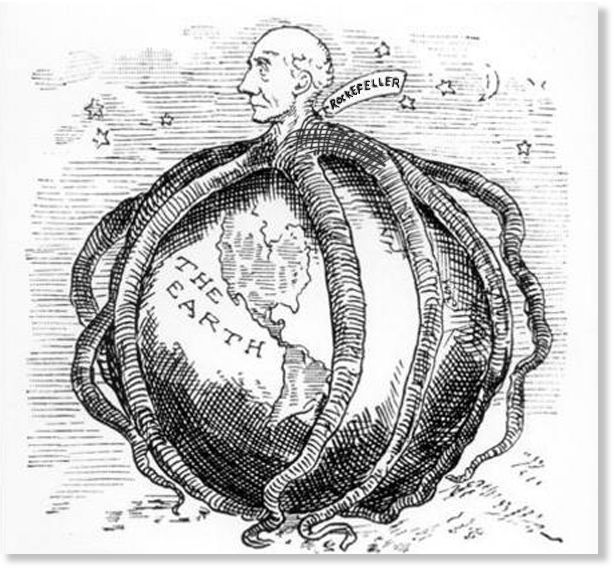
Perhaps John D.’s greatest stroke of luck, however, was not supposed to be luck at all. Rockefeller had come under increasing scrutiny by a public outraged by the unprecedented wealth he had amassed through Standard Oil. Muckraking reporters like Ida Tarbell began digging up the dirt on his rise to power through railroad conspiracies, secret deals with competitors and other shady practices. The press pictured him as a colossus with bribed politicians literally in the palm of his hand; Standard Oil was a menacing octopus with its tentacles strangling the lifeblood of the nation. Hearings began, investigations were launched, lawsuits were brought against him. And then, finally, in 1911 the Supreme Court made a monumental decision.
Narrator: On May 15th, 1911, the Supreme Court of the United States declared that Standard Oil was a monopoly in restraint of trade and should be dissolved. Rockefeller heard of the decision while golfing at Kykuit with a priest from the local Catholic church, Father J.P. Lennon.
Ron Chernow, Biographer: And Rockefeller reacted with amazing aplomb. He turned to the Catholic priest and said, “Father Lennon, have you some money?” And the priest was very startled by the question and said, “No.” And then he said, “Why?” And Rockefeller replied, “Buy Standard Oil.”
Narrator: As Rockefeller foresaw, the individual Standard Oil companies were worth more than the single corporation. In the next few years, their shares doubled and tripled in value. By the time the rain of cash was over, Rockefeller had the greatest personal fortune in history — nearly two percent of the American economy.
Ron Chernow, Biographer: And it was really losing the antitrust case that converted John D. Rockefeller into history’s first billionaire. So that Standard Oil was punished in the federal antitrust case, but John D. Rockefeller, Sr. most assuredly was not.
To the amazement of the world, Rockefeller’s punishment had in fact been his reward. Rather than being taken down a peg, the splitting up of the Standard Oil monopoly had launched him as the world’s only acknowledged billionaire at a time when the average annual income in America was $520.
Rockefeller’s story was perfectly mirrored by the story of Colonel Edwin Drake. Having struck oil in Titusville and given rise to a billion dollar global industry, Drake had not had the foresight to patent his drilling technique or even to buy up the land around his own well. He ended up in poverty, relying on an annuity from the state of Pennsylvania to scrape together a living and dying in 1880.
For the oiligarchy, the lesson of the rise and rise of Rockefeller was obvious: the more ruthlessly that monopoly was pursued, the tighter that control was grasped, the greater the lust for power and money, the greater the reward would be in the end.
From now on, no invention would derail the oil majors from their quest for total control. No competition would be tolerated. No threat to the oiligarchs would be allowed to rise.
PART TWO: COMPETITION IS A SIN
When asked how he could justify the treachery and deceit with which he pursued the creation of the Standard Oil monopoly, John D. Rockefeller is reputed to have said: “Competition is a sin.” This is the mentality of the monopolist, and it is this justification, framed as religious conviction, that drove the oiligarchs to so ruthlessly eliminate anyone who would dare rise up as a pretender to their throne.
Ironically, it was the competition between the oiligarchs in the early 20th century that helped give rise to an early external threat to their empire: alcohol fuel.
As historian Lyle Cummins has noted of the period: “The oil trust battles between Rockefeller, the Rothschilds, the Nobels and Marcus Samuel’s Shell kept prices in a state of flux, and engines often had to be adaptable to the fuel that was available.”
In many areas where oil wasn’t available, the alternative was alcohol. Ethyl alcohol had been used as a fuel for lamps and engines since the early 19th century. Although it was generally more expensive, alcohol fuel offered a stability of supply that was alluring, especially in areas like London or Paris that did not have predictable access to oil supplies.
Alcohol has a lower heat value, or BTU, than gasoline, but a series of tests by the US Geological Survey and the US Navy in 1907 and 1908 proved that the higher compression ratio of alcohol engines could perfectly offset the lower heat value, thus making alcohol and gasoline engines fuel economy equivalent.
One early supporter of alcohol fuel was Henry Ford, who designed his Model T to run on either alcohol or gasoline. Sensing an opportunity for new markets to boost the independent American farms that he felt were vital to the nation, Henry Ford told the New York Times:
“The fuel of the future is going to come from fruit like that sumach out by the road, or from apples, weeds, sawdust – almost anything. There is fuel in every bit of vegetable matter that can be fermented.”
Farmers, looking to capitalize on this, lobbied for the repeal of a $2.08 per gallon alcohol tax that had been imposed to help pay for the Civil War. They were aided by those who saw fuel alcohol as a way to break the oiligarchs’ monopoly. In support of a bill to repeal the alcohol tax, President Teddy Roosevelt told the US Congress in 1906:
“The Standard Oil Company has, largely by unfair or unlawful methods, crushed out home competition. It is highly desirable that an element of competition should be introduced by the passage of some such law as that which has already passed the House, putting alcohol used in the arts and manufactures upon the free list.”
The alcohol tax was repealed in 1906 and for a time corn ethanol at 14 cents a gallon was cheaper than gasoline at 22 cents a gallon. The promise of cheap, unpatentable, unmonopolizable fuel production, production open to anyone with raw vegetable matter and a still, swept the nation.
But cheap, plentiful fuel that can be grown and produced locally and independently is not what the oiligarchs had in mind.
A 1909 USGS report comparing gas and alcohol engines had noted that a significant point in alcohol fuel’s favour was that there were fewer restrictions on alcohol engines. For the oiligarchs, the answer was simple: find a way to place greater restrictions on alcohol engines. Thankfully for them, the answer to their problem was already gaining popular support.
In the 19th century, America had a drinking problem. By 1830, the average American over 15 years old drank seven gallons of pure alcohol per year, three times higher than today’s average. This led to the first anti-alcohol movements in the 1830s and 1840s, and the formation of the Prohibition Party in 1869 and the Women’s Christian Temperance Union in the 1870s. The movement enjoyed widespread and growing support but had few political successes; Maine flirted with prohibition by outlawing the sale and manufacture of liquor in 1851, but the ban only lasted five years.
This changed with the formation of the Anti-Saloon League in Standard Oil’s birth state of Ohio in 1893. The ASL was started by John D. Rockefeller’s long-time personal friend Howard Hyde Russell and was bankrolled in part by generous annual donations from Rockefeller himself. The ASL, with Rockefeller’s backing, quickly became the driving force behind a national movement to outlaw the production and sale of alcohol.
Rockefeller was a teetotaler himself, not from moral concern but because he was afraid that “good cheer among friends” would lead to his downfall in business. Stephen Harkness, one of the silent partner investors in Standard Oil and a director in the company until his death, had caught Rockefeller’s eye when he made a fortune buying up whiskey in advance of a new excise tax that he had been tipped about and selling it at a huge profit after the tax kicked in.
No, Rockefeller and Standard Oil were not concerned about the moral state of the nation…except as far as it impacted their bottom line. But when prohibition did come in 1920, it had an interesting side effect: although it didn’t ban the use of ethanol as a fuel directly, it did lead to increasingly burdensome restrictions requiring producers to add petroleum products to their ethanol to make it poisonous before it could be sold. Alcohol fuel, now completely unable to compete with gasoline, was abandoned altogether by the automobile industry.
Another existential threat to the vast fortunes of the early oiligarchs was to require an even greater effort at social engineering: public transportation.
By the end of World War I, private car ownership was still a relative rarity; only one in 10 Americans owned a car. Rail was still the transportation of choice for the vast majority of the public, and city-dwellers in most major cities relied on electric trolley networks to transport them around town. In 1936, General Motors formed a front company, “National City Lines,” along with Firestone Tire and Standard Oil of California, to implement a process of “bustitution”: scrapping streetcars and tearing up railways to replace them with GM’s own buses running on Standard Oil supplied diesel. The plan was remarkably successful.
“By the end of the 1940s, GM had bought and scrapped over one hundred municipal electric transit systems in 45 cities and put gas-burning GM buses on the streets in their place. By 1955 almost 90% of the electric streetcar lines in the United States had been ripped out or otherwise eliminated.”
The cartel had been careful to hide their involvement in National City Lines, but it was revealed to the public in 1946 by an enterprising retired naval lieutenant commander, Edwin J. Quinby. He wrote a manifesto exposing what he called “a careful, deliberately planned campaign to swindle you out of your most important and valuable public utilities–your Electric Railway System.” He uncovered the oiligarchs’ stock ownership of National City Lines and its subsidiaries and detailed how they had step by step bought up and destroyed the public transportation lines in Baltimore, Los Angeles, St. Louis and other major urban centres.
Quinby’s warning caught the attention of federal prosecutors and in 1947 National City Lines was indicted for conspiring to form a transportation monopoly and conspiring to monopolize sales of buses and supplies. In 1949, GM, Firestone, Standard Oil of California and their officers and corporate associates were convicted on the second count of conspiracy. The punishment for buying up and dismantling America’s public transportation infrastructure? A $5,000 fine. H. C. Grossman, who had been the director of Pacific City Lines when it oversaw the scrapping of LA’s $100 million Pacific Electric system, was fined exactly $1.
Unsurprisingly, GM and its associates did not remain in the doghouse for long. In 1953 President Eisenhower appointed Charles Wilson, then the President of General Motors, as Secretary of Defense. Wilson, with Francis DuPont of the Rockefeller-connected DuPont family as Chief Administrator of Federal Highways, oversaw one of the largest public works projects in American history: the creation of the interstate highway system. With a war-era excise tax on train tickets still in place and federally funded highways and airports providing cheaper alternatives, rail travel declined a startling 84% between 1945 and 1964.
This social engineering paid off well for Standard Oil and its growing list of petrochemical associates. In the two and a half decades after the outbreak of World War II, vehicle production in Detroit almost tripled, from 4.5 million cars a year in 1940 to over 11 million in 1965. As a result, sales of refined gasoline over the same period rose 300%.
But Rockefeller was not the only oiligarch working to crush all opposition to his monopoly. Across the pond, the European oiligarchs were working to protect their own oil investments from upstart competitors.
In 1889, a consortium of German investors led by Siemens’ Deutsche Bank obtained a concession from the Turkish government for extension of a railway line connecting Berlin to Basra on the Persian Gulf via Baghdad in what was then part of the Ottoman Empire. The Berlin-Baghdad Railway concession was for ninety-nine years and came with mineral rights for twenty kilometers on either side of the line…an especially lucrative deal since the rail cut right through the heart of the still untapped Mesopotamian oil regions south of Mosul along the Tigris River.
For the powers behind the British empire, concerned with the military rise of Germany, this deal was unacceptable.
William Engdahl: Well Germany in the end of the 19th century was looking for outlets for its exports — its industrial exports — as the German economy was growing like China’s has grown in the last 30 years. And they decided that Turkey would be an ideal strategic trade partner for Germany. And Georg von Siemens, one of the directors of Deutsche Bank, came up with a strategy to extend a railway from Berlin all the way down to Baghdad — which was then part of the Ottoman Empire, Baghdad and Iraq today, near the Persian Gulf. German military began training the Turkish military. German industry began investing in Turkey. They saw a huge potential market to begin bringing Turkey into the 20th century economically. Deutsche Bank also negotiated mineral rights — I think it was 20 kilometres either side of the railway — and it was already known in 1914 that Mosul and these other areas contained huge petroleum deposits.
Well, why is that significant? At the end of the 19th century, Jack Fisher–the head of the Admiralty and the head of the Royal Navy–advocated the conversion of the British Navy from coal-fired to oil-fired. That it would have a qualitative strategic improvement in every aspect of warship design. And since Britain didn’t know that they had any oil back then they went to Persia and swindled the Shah out of oil rights in Persia. They went to Kuwait and backed a coup d’etat of the Al-Sabah family to be a British pawn, and they literally wrote a contract with him that nothing that Kuwait does will be done without approval of the British Governor. And Kuwait was known to have oil lying right on the Persian Gulf.
The British looked at this railway plan of the Germans going right down to Baghdad and said ‘My God! You can put soldiers on rail cars and bring them down and threaten the oil lifeline of the British Navy.’ This is a strategic move by the Germans. It also would make Germany independent of the British control of the seas. They would have a landline much like the Chinese “One Belt, One Road” infrastructure for high speed rails going throughout Eurasia into Russia, on into Belarus and Western Europe that removes the United States’ Navy ability to control China and control Central Asia to a great extent.
The British oiligarchs, including the British crown with its hidden controlling stake in Anglo-Persian Oil and the Rothschild’s merchant Marcus Samuel at Royal Dutch Shell, sought to counter this German threat to their commercial and strategic interests. They used Armenian-born naturalized British citizen Calouste Gulbenkian–the architect of the Royal Dutch / Shell merger–in order, as he later recalled “to see British influence get the upper hand in Turkey” against the Germans. If that was his task, it was a remarkable success.
In 1909 the British set up the Turkish National Bank, which was “Turkish” in name only. Founded by London banker Sir Edward Cassel and with directors like Hugo Baring of the Barings banking family, Cassel himself, and Gulbenkian, the Bank set up the Turkish Petroleum Company in 1912. Formed explicitly to exploit the petroleum-rich oil fields of Iraq, then part of the Ottoman Empire, Gulbenkian brokered a deal that forced Deutsche Bank, with its 40 kilometre concessions along the oil-rich Baghdad railway line, into a junior partnership in the company. The stock was split so the British government’s Anglo-Persian Oil Company owned half the shares, with Royal Dutch Shell and Deutsche Bank splitting the other half.
Their plan to take over Germany’s Turkish oil interests had been successful, but in an amazing irony, it didn’t even matter. Gulbenkian finished negotiations for the Iraqi oil concession on June 28, 1914, the same day Archduke Ferdinand was shot in Sarajevo. An alliance the British had been brokering for years to constrain the rising German threat, an alliance involving France and Russia, kicked into motion and the world was engulfed in war. By the end of World War I, the British and their allies had taken over Iraq and its oil deposits anyway, Germany had been completely cut out, and Gulbenkian, their scheming servant, received 5% of all oil field proceeds in the newly minted country.
As the century wore on, the oil industry grew beyond the control of the handful of families that had dominated it since its inception. Oil deposits were located around the globe and the resources of entire nation states were marshaled to control them. Now, threats to the oiligarchs and their interests required multi-lateral, multi-national responses and the consequences of those deals were felt worldwide.
The story of the Oil Shock of 1973 as it has been delivered to us by the history books is well known.
Narrator: By the late 1960s the nation relied on imported oil to keep the economy strong. Then in the early 1970s oil-dependent America’s nightmares came true: 13 oil-producing countries in the Middle East and South America formed OPEC, the Organization of Petroleum Exporting Countries. In 1973 OPEC placed an oil embargo on the US and other nations that had supported Israel against the Arab states in the Yom Kippur war. The American economy went into a tailspin as gas shortages gripped the nation.
Few, however, know that the crisis and its ensuing response was in fact prepared months ahead of time at a secret meeting in Sweden in 1973. The meeting was the annual gathering of the Bilderberg Group, a secretive cabal formed by Prince Bernhard of the Netherlands in 1954.
The Dutch royal family not only gave its royal imprint to Royal Dutch Petroleum, they are still rumoured to be, along with the Rothschilds, one of the largest shareholders in Royal Dutch Shell, from the days when Queen Wilhelmina’s Anglo-Dutch Petroleum holdings and other investments made her the world’s first female billionaire right through to today. Bernhard’s guest list at the Bilderberg Group reflected his position in the oiligarchy; alongside him at the Swedish conference were David Rockefeller of the Standard Oil dynasty and his protege Henry Kissinger, Baron Edmond de Rothschild, E.G. Collado, the Vice President of Exxon, Sir Denis Greenhill, director of British Petroleum, and Gerrit A. Wagner, president of Bernhard’s own Royal Dutch Shell.
At the meeting in Sweden, held five months before the oil crisis began, the oil-igarchs and their political and business allies were planning their response to a monetary crisis that threatened the world dominance of the US dollar. Under the Bretton Woods system, negotiated in the final days of World War II, the US dollar would be the backbone of the world monetary system, convertible to gold at $35 per ounce with all other currencies pegged to it. Increasing US expenditures in Vietnam and decreasing exports caused Germany, France, and other nations to start demanding gold for their dollars.
With the Federal Reserve’s official gold holdings plunging and unable to stem the tide of demand, Nixon abandoned Bretton Woods in August 1971, threatening the dollar’s position as the world reserve currency.
Richard Nixon: Accordingly, I have directed the Secretary of the Treasury to take the action necessary to defend the dollar against the speculators. I have directed Secretary Connally to suspend temporarily the convertability of the dollar into gold or other reserve assets except in amounts and conditions determined to be in the interest of monetary stability and in the best interest of the United States.
As leaked documents from the 1973 Bilderberg meeting show, the oiligarchs decided to use their control over the flow of oil to save the American hegemon. Acknowleding that OPEC “could completely disorganize and undermine the world monetary system,” the Bilderberg attendees prepared for “an energy crisis or an increase in energy costs,” which, they predicted, could mean an oil price between $10 and $12, a staggering 400% increase from the current price of $3.01 per barrel.
Five months later, Bilderberg attendee and Rockefeller protege Henry Kissinger, acting as Nixon’s Secretary of State, engineered the Yom Kippur War and provoked OPEC’s response: an oil embargo of the US and other nations that had supported Israel. On October 16, 1973, OPEC raised oil prices by 70%. At their December meeting, the Shah of Iran demanded and received a further price raise to $11.65 a barrel, or 400% of oil’s pre-crisis price. When asked by Saudi King Faisal’s personal emissary why he had demanded such a bold price increase, he replied: “Tell your King, if he wants the answer to this question, he should go to Washington and ask Henry Kissinger.”
In the second move of the operation, Kissinger helped negotiate a deal with Saudi Arabia: in exchange for US arms and military protection, the Saudis would price all their future oil sales in dollars and recycle those dollars through treasury purchases via Wall Street banks. The deal was a bonanza for the oiligarchs; not only did they get to pass the price increases on to the consumers, but they benefited from the huge flows of money into their own banks. The Shah of Iran parked the National Iranian Oil Company’s revenues in Rockefeller’s own Chase Bank, revenues that reached $14 billion per year in the wake of the oil crisis.
With the creation of this new system, the “petrodollar“, the oiligarchs had reached unprecedented levels of control over the economy. Not only that, they had backed the world monetary system with their commodity, oil, and brought potential competition from upstart producer nations under their control all in one step.
But for the insatiable appetites of these monopolist titans, mere control over the world’s monetary system was not enough…
PART THREE: THE WORLD IN THEIR IMAGE
In the nineteenth century, railroad conspiracies and predatory pricing had been enough to assure the oiligarchs’ monopoly. But by the time that the British crown, the Dutch royal family, the Rothschilds and the other European oiligarchs began opening up the Middle East and the Far East to oil exploration in the early twentieth century, the goal was no longer to maximize profits or control the oil industry. It was not even to control international diplomacy. It was to control and shape the world itself. Its resources. Its environment. And its people.
In order to achieve this goal, the oiligarchy would need a facelift.
In the current age, with the Rockefeller name now more likely to be associated with Rockefeller Plaza or Rockefeller University than Standard Oil, it is difficult to understand just how hated John D. was in his own day. He was the head of the Standard Oil Hydra, an octopus strangling the world in his tentacles, a cutthroat gardener pruning the competitors from the flower of his oil monopoly. As one of the richest men the world had ever known, he was an easy target for the average working man’s frustrations and a magnet for the poor seeking help.
Judith Sealander, Historian: He received on average 50 to 60,000 letters a month, asking for help. Dozens of people followed him in the street. Literally, crowds stood around the Standard Oil offices waiting for him to come out. Little children, painfully thin, crying in the street and so on. Rockefeller felt overwhelmed.
Besieged by the downtrodden, despised by the working man, hounded by Ida Tarbell and the muckraking press, John D. had the mother of all PR problems. The answer was simple: invent the PR industry. He hired Ivy Ledbetter Lee, a journalist-turned-communications expert who invented the modern public relations industry to burnish the Rockefellers’ tarnished image. It was Lee that suggested giving the family name to Rockefeller Center and filming John D. handing out dimes in public.
Narrator: An early master of public relations, Lee used the media which the muckrakers had used to disgrace Rockefeller to turn him into a sympathetic figure. Ivy Lee recognized early the power of the new moving picture and used newsreels to show a remarkably benevolent Rockefeller.
John D. Rockefeller: I am very grateful to you and to a host of people who are so kind and good to me all the time.
Second Man: Why, because you’re so good to everybody.
John D. Rockefeller: Yes, you are.
As Ivy Lee began to control his public image he became oddly a kind of American character, and people kind of warmed to him in a bizarre sort of way. It was like having Frankenstein on the loose walking around New York City or something like that, with a cane and a long hat.
Narrator: Although this plane never takes off, this photo opportunity was presented as Senior’s first flight. Perhaps Ivy Lee’s most brilliant public relations move was the casting of Rockefeller as ‘The Man Who Gave out Dimes.’
Man off camera: Don’t you give dimes, Mr. Rockefeller? Please, go ahead.
Woman: Thank you, sir.
Man: Thank you very much.
John D. Rockefeller: Thank you for the ride!
Man: I consider myself more than amply paid.
John D. Rockefeller: Bless you! Bless you! Bless you!
These PR stunts seem obvious and ham-handed by today’s standards, but they were effective enough: to this day people leave dimes on the stone marker at the base of the 70 foot Egyptian obelisk that towers over John D.’s final resting place in Cleveland’s Lake View Cemetery. But it was not stage-managed photo opportunities like these that transformed Rockefeller into a public hero.
In order to win the public over, he was going to have to give them what they wanted. And what they wanted wasn’t difficult to understand: money. But just as his father, Devil Bill, had taught him to do in all his business dealings, Rockefeller made sure to get the better end of the bargain. He would “donate” his great wealth to the creation of public institutions, but those institutions would be used to bend society to his will.
As every would-be ruler throughout history has realized, society has to be transformed from the ground up. Americans in the 19th century still prized education and intellectual pursuits, with the 1840 census finding unsurprisingly that the United States–a nation that had been mobilized by tracts like Thomas Paine’s remarkably popular Common Sense–was a nation of readers, with a remarkable 93% to 100% literacy rate. Before the first compulsory schooling laws in Massachusetts in 1852, education was private and decentralized, and as a result classical education, including study of Greek and Latin and a solid grounding in history and science, was widespread.
But a nation of individuals who could think for themselves was anathema to the monopolists. The oiligarchs needed a mass of obedient workers, an entire class of people whose intellect was developed just enough to prepare them for lives of drudgery in a factory. Into the midst stepped John D. Rockefeller with his first great act of public charity: the establishment of the University of Chicago.
He was aided in this task by Frederick Taylor Gates, a Baptist minister that Rockefeller befriended in 1889 and who would go on to be John D.’s most trusted philanthropic adviser. Gates would go on to write a short tract, “The Country School of Tomorrow,” that laid out the Rockefeller plan for education:
“In our dream, we have limitless resources, and the people yield themselves with perfect docility to our molding hand. The present educational conventions fade from our minds; and, unhampered by tradition, we work our own good will upon a grateful and responsive folk. We shall not try to make these people or any of their children into philosophers or men of learning or science. We are not to raise up from among them authors, orators, poets, or men of letters. We shall not search for embryo great artists, painters, musicians. Nor will we cherish even the humbler ambition to raise up from among them lawyers, doctors, preachers, politicians, statesmen, of whom we now have ample supply.”
Although Rockefeller’s resources weren’t exactly limitless, they might as well have been. In 1902 he established the General Education Board to help implement Gates’ vision for the country school of tomorrow with a staggering $180 million endowment.
The Rockefeller influence on education was felt almost immediately, and it was amplified by help from fellow monopolists of the era who were approaching the topic of philanthropy from the same angle.
Although best known as a steel magnate, Andrew Carnegie’s fortune started on the railroads transporting Rockefeller’s Standard Oil around the country, and was greatly magnified by a lucrative investment in property near Oil Creek that provided steady, profitable oil sales. In 1905 he established the Carnegie Foundation for the Advancement of Teaching, a tax-free foundation through which Carnegie and his appointees could direct the development of the education system in the the United States, and, eventually, worldwide. In 1910, Rockefeller followed suit by establishing the Rockefeller Foundation, which became the tax-free umbrella organization for his philanthropic ambitions.
As the Reece Committee–a Congressional investigation into the activities of these tax-free foundations in the 1950s–discovered, it wasn’t long before Carnegie’s Endowment approached Rockefeller’s Foundation with a proposal: to cooperate on their shared desire to transform the American education system in their own image. Norman Dodd, the director of research for the Congressional committee who was granted access to the Carnegie Endowment’s board minutes, explains:
So they approach the Rockefeller Foundation with a suggestion: that portion of education which could be considered domestic should be handled by the Rockefeller Foundation, and that portion which is international should be handled by the Endowment.
They then decide that the key to the success of these two operations lay in the alteration of the teaching of American History. So, they approach four of the then most prominent teachers of American History in the country — people like Charles and Mary Byrd. Their suggestion to them is this, “Will they alter the manner in which they present their subject”” And, they get turned down, flatly.
So, they then decide that it is necessary for them to do as they say, i.e. “build our own stable of historians.” Then, they approach the Guggenheim Foundation, which specializes in fellowships, and say” “When we find young men in the process of studying for doctorates in the field of American History, and we feel that they are the right caliber, will you grant them fellowships on our say so? And the answer is, “Yes.”
So, under that condition, eventually they assemble twenty (20), and they take these twenty potential teachers of American History to London. There, they are briefed in what is expected of them — when, as, and if they secure appointments in keeping with the doctorates they will have earned.
That group of twenty historians ultimately becomes the nucleus of the American Historical Association. And then, toward the end of the 1920’s, the Endowment grants to the American Historical Association four hundred thousand dollars ($400,000) for a study of our history in a manner which points to what this country look forward to, in the future.
That culminates in a seven-volume study, the last volume of which is, of course, in essence, a summary of the contents of the other six. The essence of the last volume is this: the future of this country belongs to collectivism, administered with characteristic American efficiency.
With this base for transformation firmly established, the Rockefeller Foundation and like-minded organization embarked on a program so ambitious that it almost defies comprehension.
They transformed the practice of medicine.
As usual, the oiligarchs that funded this change were also there to profit from it, and once again John D. took his queue from “Devil” Bill’s example. William Rockefeller had called his brand of snake oil “Nujol,” for “new oil,” and Standard Oil spun off “Nujol” as a laxative under their Stanco subsidiary. Manufactured on the same premises as “Flit,” an insecticide also derived from Standard Oil’s byproducts, “Nujol” sold at the druggist for 28 cents per six ounce bottle; it cost Standard Oil less than one-fifth of a cent to manufacture. Pharmaceuticals provided a lucrative new opportunity for the oiligarchs, but in a turn-of-the-century America that was still largely based on naturopathic, herbal remedies, it was a tough sell. The oiligarchy went to work changing that.
In 1901 John D. established the Rockefeller Institute for Medical Research. The Institute recruited Simon Flexner, a pathology professor at the University of Pennsylvania, to serve as its director. His brother, Abraham, was an educator who was contracted by the Carnegie Foundation to write a report on the state of the American medical education system. His study, The Flexner Report, along with the hundreds of millions of dollars that the Rockefeller and Carnegie Foundations were to shower on medical research in the coming years, resulted in a sweeping overhaul of the American medical system. Naturopathic and homeopathic medicine, medical care focused on un-patentable, uncontrollable natural remedies and cures was now dismissed as quackery; only drug-based allopathic medicine requiring expensive medical procedures and lengthy hospital stays was to be taken seriously.
Narrator: The fortunes of Carnegie, Morgan and Rockefeller financed surgery, radiation and synthetic drugs. They were to become the economic foundations of the new medical economy.
G. Edward Griffin: The takeover of the medical industry was accomplished by the takeover of the medical schools. Well, the people that we’re talking about, Rockefeller and Carnegie in particular, came to the picture and said ‘We will put up money.’ They offered tremendous amounts of money to the schools that would agree to cooperate with them. The donors said to the schools: ‘We’re giving you all this money, now would it be too much to ask if we could put some of our people on your Board of Directors to see that our money is being spent wisely?’ Almost overnight all of the major universities received large grants from these sources and also accepted one, two or three of these people that I mentioned on their Board of Directors and the schools literally were taken over by the financial interests that put up the money.
Now what happened as a result of that is the schools did receive an infusion of money, they were able to build new buildings, they were able to add expensive equipment to their laboratories, they were able to hire top-notch teachers, but at the same time as doing that they schewed the whole thing in the direction of pharmaceutical drugs. That was the efficiency in philanthropy.
The doctors from that point forward in history would be taught pharmaceutical drugs. All of the great teaching institutions in America were captured by the pharmaceutical interests in this fashion, and it’s amazing how little money it really took to do it.
The oiligarchy birthed entire medical industries from their own research centers and then sold their own products from their own petrochemical companies as the “cure.” It was Frank Howard, a Standard Oil of New Jersey executive, who would go on to persuade Alfred Sloan and Charles Kettering to donate their fortunes to the cancer center that would then bear their name. As director of research at Sloan-Kettering, Howard appointed Cornelius Rhoads, a Rockefeller Institute pathologist, to develop his wartime research on mustard gas for the US Army into a new cancer therapy. Under Rhoads’ leadership, nearly the entire program and staff of the Chemical Warfare Service were reformed into the SKI drug development program, where they worked on converting mustard gas into chemotherapy. And once again, the Rockefeller’s own snake oil was being sold as a cancer cure-all.
The oiligarchs’ interest in the burgeoning pharmaceutical industry converged in companies like I.G. Farben, a drug and chemical cartel formed in Germany in the early 20th century. Royal Dutch’s Prince Bernhard served on an I.G. Farben subsidiary’s board in the 1930s and the cartel’s American operation, set up in cooperation with Standard Oil, included on its board Standard Oil president Walter Teagle as well as Paul Warburg of Kuhn, Loeb & Co., itself headed by Jacob Schiff of the Rothschild broker family. At its height, I.G. Farben was the largest chemical company in the world and the fourth largest industrial concern in the world, right behind Standard Oil of New Jersey.
The company was broken up after World War II, but like Standard Oil, its various pieces remained intact and today BASF, one of its chemical offshoots, remains the largest chemical company in the world, while Bayer and Sanofi, two of its pharmaceutical offshoots are among the largest pharmaceutical companies in the world.
Not content merely to monopolize the fields of education and medicine, the same oiligarchical interests banded together to take control of America’s finances. In 1910 John D. Rockefeller Jr.’s own father-in-law, Senator Nelson Aldrich, Frank Vanderlip of the National City Bank, and Paul Warburg, as well as various agents of J.P. Morgan, met in complete secrecy on Jekyll Island to hammer out the details of what would go on to become the Federal Reserve, America’s central bank. The Fed, established in 1913, would be run by hand-picked appointees of the oiligarchy and their banking associates, including, perhaps inevitably, Standard Oil president and American I.G. director Walter Teagle.
The Rockefeller family would go on to formally enter the banking field in the 1950s when James Stillman Rockefeller, the grandson of John D.’s brother, was appointed director of National City Bank. Meanwhile John D.’s own grandson, David Rockefeller, would go on to take over Chase Manhattan Bank, the long-time banking partner of the Standard Oil empire.
In this move the Rockefellers’ story perfectly mirrored that of their fellow oiligarchs the Rothschilds. Whereas the Rothschilds had supplemented their banking fortune with their oil interests, the Rockefellers supplemented their oil fortune with banking interests.
Springboarding from success to success as they consolidated monopolies across every field of human activity, the oiligarchs’ ambitions became even larger. This time, their goal was to consolidate control over the very food supply of the world itself, and once again they would use philanthropy as the cover for their business takeover.
Narrator: The Green Revolution began in 1943 when plant geneticist Norman Borlaug and a team of researchers arrived on Mexican soil. His goal was to improve agricultural techniques and biotechnological methodologies which in turn would help alleviate starvation and improve the living quality of developing nations. Creating new genetically modified strains of wheat, rich, maize and other crops, Borlaug planned to win the battle against world hunger. The hope was that these new crops and farming techniques would rescue third world countries from the brink of starvation.
That’s exactly what happened. The agricultural innovations brought to the poverty-stricken countries gave the farmers the skills and resources necessary to sustain themselves. This triggered a chain of events that would allow these once-struggling nations to survive. Agricultural exports soared in quantity and diversity and allowed the countries to become self-sufficient.
As the genetically modified crops thrived, farmers were able to use their increased income to purchase newer and superior farming machinery. This increase in revenue made farming easier, more reliable and more efficient. The Green Revolution led to the modernization of agriculture and has had a profound social, economic and political impact on the world.
The Mexican government turned to the Rockefeller Foundation in their endeavour to nourish Mexico through agriculture.
Norman Borlaug, needless to say, was a researcher for the Rockefeller Foundation, and the Green Revolution, for whatever increase in yields it brought about, also created markets for the oiligarchs’ own interest in the petrochemical fertilizer industry and gave rise to the “ABCD” seed cartel of Archer Daniels Midand, Bunge, Cargill and Louis Dreyfus. These companies, along with their associated interests in the food packaging and processing industry, formed the core of American “agribusiness,” a concept developed at Harvard Business School in the 1950s with the help of research conducted by Wassily Leontief for the Rockefeller Foundation.
The American agribusiness giants shared a common goal: the transformation of third world agriculture into a captive market for their goods. From this perspective, the project was a runaway success. By the 1970s the Rockefeller Standard Oil network and its cronies in the nitrogen fertilizer industry (including DuPont, Dow Chemical, and Hercules Powder) had broken into markets around the world, markets conveniently forced open for them by the US government itself under President Johnson’s “Food for Peace” program, which mandated the use of petrochemical-dependent agricultural technologies (fertilizers, tractors, irrigation, etc.) by aid recipients.
Unable to afford these new technologies themselves, the impoverished third-world “beneficiaries” of this “revolution” relied on loans from the International Monetary Fund and the World Bank handled by Rockefeller’s own Chase Manhattan Bank and guaranteed by the US government.
The real costs of the Green Revolution, economic, agricultural and environmental are seldom tallied. Access to these debt-financed petrochemical-dependent technologies exacerbated the difference between the rich landowning class and the landless peasants in countries like India, where land reform and abolition of usury were dropped from the political agenda after the Green Revolution took over.
Even then, the revolution’s main success, its increase in agricultural yields, has been oversold. Yield growth across India actually slowed after the introduction of agribusiness. The environmental destruction is even more devastating. An overview in the December 2000 edition of Current Science notes: “The gree n revolution has not only increased productivity, but it has also [produced] several negative ecological consequences such as depletion of lands, decline in soil fertility, soil salinization, soil erosion, deterioration of environment, health hazards, poor sustainability of agricultural lands and degradation of biodiversity. Indiscriminate use of pesticides, irrigation and imbalanced fertilization has threatened sustainability.”
The Rockefeller Foundation even acknowledges the critiques of the Green Revolution it funded into existence, insisting that “current initiatives take into account lessons learned.” Even so, the Foundation continues to fund research and write reports on how to improve prospects for agribusiness investment in its target markets.
As egregious as the Green Revolution was and continues to be, however, in many ways it was just the prelude to an even more ambitious project: the Gene Revolution. Now the project is not merely to monopolize the technologies, supplies and chemical inputs for agriculture worldwide, but to monopolize the food supply itself through the replacement of the world’s natural seeds with patentable genetically modified crops.
The players involved in this “Gene Revolution” are almost identical to the players in the Green Revolution, with I.G. Farben offshoots Bayer CropScience and BASF PlantScience mingling with traditional oiligarch associate companies like Dow AgroScience, DuPont Biotechnology, and, of course, Monsanto, all funded by the Rockefeller Foundation and fellow “philanthropists” at the Ford Foundation, the Bill & Melinda Gates Foundation and like-minded organizations.
The convergence of corporate, “philanthropic,” governmental and inter-governmental interests in promoting GM crops around the world can be seen in the bewildering array of research institutes, industry associations, and “consultative groups” devoted to the case. The Rockefeller-funded International Rice Research Institute (IRRI), the Rockefeller/Monsanto/USAID brainchild International Service for the Acquisition of Agri-biotech Applications (ISAAA), the Rockefeller/Ford/World Bank created Consultative Group of International Agricultural Research (CGIAR) and dozens of other bland, benign-sounding organizations research and promote GM crops in target markets around the globe, with the profits ending up in the oiligarchs’ coffers.
A representative example of this story is the agribusiness neocolonization of Argentina, where Monsanto ran an elaborate “bait-and-switch” to get the country hooked on its genetically modified Roundup Ready soybeans before demanding royalties on the crops that were by then already growing. DuPont then took over, magnanimously beginning a “Protein for Life” programme to foist their own GM soybeans on the country’s poor.
The same scene has played itself out in country after country, where cartel-developed GM crops are foisted on emerging economies through “food aid,” usually during times of famine when those countries are especially vulnerable. Only a handful of countries like Zambia or Angola have outright rejected this GMO takeover of their food supply, generously subsidized by the US government to the benefit of the agribusiness cartel.
Conclusion: Monopolizing Life
From cutthroat pioneers of the early oil industry to Machiavellian social engineers and geopolitics schemers, the oiligarchs have come a long way since the days of Devil Bill’s snake oil cure-alls. But his use of every form of deception and trickery to swindle the public informed how John D. and the rest of the oiligarchs built up their business interests.
As the 20th century drew to a close, it was obvious that for the powerful cartel that built the oil industry–the Rockefellers, the Rothschilds, the British and Dutch royal families–it was no longer about oil, if it ever really was. The takeover of education, of medicine, of the monetary system, of the food supply itself, showed that the aim was much greater than a mere oil monopoly: it was the quest to monopolize all aspects of life. To erect the perfect system of control over every aspect of society, every sector from which any threat of competition to their power could emerge.
They had been remarkably, almost unbelievably, successful. From oil well to gas pump, farm to fork, hospital to pharmaceutical, drill rig to dollar bill, there was almost no aspect of society that was not under control.
But the oiligarchs are not done yet. Their next project, launched in the late 20th century, is almost too ambitious to be comprehended. It is not about oil. It is not about money. It is about the monopolization of life itself. They have spent decades preparing the path for this takeover and marshaled their mind-boggling resources in service of the task.
And the vast majority of the world’s population, still playing the shell game that the oiligarchs perfected and abandoned long ago, are about to fall right into their hands yet again.
Martin Shkreli: He's a poster boy for White-On-Everybody Crime.
_____________
Shkreli, CEO Reviled for Drug Price Gouging, Arrested on Securities Fraud Charges
By Christie Smyth Martin Shkreli, the boyish drug company entrepreneur, who rocketed to infamy by jacking up the price of a life-saving pill from $13.50 to $750, was arrested by federal agents at his Manhattan home early Thursday morning on securities fraud related to a firm he founded.
Shkreli, 32, ignited a firestorm over drug prices in September and became a symbol of defiant greed. The federal case against him has nothing to do with pharmaceutical costs, however. Prosecutors in Brooklyn charged him with illegally taking stock from Retrophin Inc., a biotechnology firm he started in 2011, and using it to pay off debts from unrelated business dealings. He was later ousted from the company, where he’d been chief executive officer, and sued by its board.
In the case that closely tracks that suit, federal prosecutors accused Shkreli of engaging in a complicated shell game after his defunct hedge fund, MSMB Capital Management, lost millions. He is alleged to have made secret payoffs and set up sham consulting arrangements. A New York lawyer, Evan Greebel, was also arrested early Thursday. He's accused of conspiring with Shkreli in part of the scheme.
Retrophin replaced Shkreli as CEO “because of serious concerns about his conduct,” the company said in a statement. The company, which hasn’t been accused of any wrongdoing, has “fully cooperated with the government investigations into Mr. Shkreli.”
Shkreli’s lawyer declined to comment. Greebel, who worked at Katten Muchin Rosenman LLP and served as lead outside counsel to Retrophin from 2012 to 2014, helped Shkreli in several schemes, prosecutors said. A spokeswoman for Katten Muchin declined to comment; a spokeswoman for Kaye Scholer, where Greebel now works, said he joined the firm after the alleged activities occurred.
Authorities outlined years of investment losses and lies Shkreli allegedly told his investors almost from the moment he began managing money. By age 26, they said, he got nine investors to place $3 million with him, began losing their money and covering it up. Within a year, his fund's account was down to $331.
Pharmaceutical giant Pfizer has sealed a more than $150 billion merger
with fellow drug maker Allergan, marking one of the largest takeovers in
the history of the healthcare industry. Because Allergan is
headquartered in Ireland, the deal will allow Pfizer to avoid billions
in U.S. taxes. It’s believed to be the largest example to date of a
so-called tax inversion – where a U.S. firm acquires a firm based
overseas in order to dodge U.S. taxes.—DemocracyNow
By Beth Mole
In what’s called a “reverse-inversion,” Allergan, a small Dublin-based drug company that makes products such as Botox, will technically buy the US-based pharmaceutical behemoth Pfizer, which makes products such as Viagra and Lipitor.
The $160 billion merger, officially announced Monday, will allow Pfizer to move its executive offices to Ireland, thus lowering its tax rate, while also morphing into the world’s largest drug maker.
Such inversions, which are said to cost the American government billions in lost tax revenue, have drawn scorn from the Obama Administration and the Treasury Department. Last year, President Obama referred to the deals as “unpatriotic” loopholes and proposed to close them. And last week, the Treasury announced new rules to make such deals more difficult.
But Pfizer’s reverse-inversion skirts the rules, in part by keeping ownership split somewhat evenly between the two companies. After the deal is complete, current shareholders of Allergan, which has the majority of its operations in the US, will own 44 percent of the mega company. The remaining 56 percent will be owned by current Pfizer shareholders.
This is how the various "drug enforcement" law agencies make sure they have big budgets and a job to do.
By John Temple
The feds could choke off the supply of pills flooding American streets tomorrow. Instead, they let Big Pharma crank out 151 tons of it last year.
The federal government is actively fueling a killer drug epidemic behind closed doors.
The Drug Enforcement Administration—tasked with fighting the war on drugs—has for the past two decades approved ever-greater quantities of controlled substances like oxycodone for manufacture and sale in the U.S. by pharmaceutical companies.
In 1993, the DEA allowed pharmaceutical companies to manufacture 3,520 kilograms of oxycodone. In 2015, the DEA authorized production of 137,500 kilograms of oxycodone. That’s a 39-fold increase in 22 years, the equivalent of turning two Buicks into four Boeing 737s. Either Americans are in 39 times more pain than we were 20 years ago, or something else is wrong.
Martin Shkreli: Wall Street parasite turns out to be a scam artist of the first order.
By Travis Gettys This isn’t the first time Martin Shkreli, the most hated man on the Internet, has attracted criticism for his unscrupulous business dealings.
Shkreli has ignited a firestorm after purchasing the rights to Daraprim, a 62-year-old drug used for treating life-threatening parasitic infections in babies and AIDS patients, and raising the price overnight from $13.50 per tablet to $750.
He gave an interview Monday to Bloomberg, which has taken a “special interest” in the 32-year-old Shkreli after the “self-trained biologist” dramatically changed his position on biotech futures.
“We’ve wondered whether, after years of betting on biotech stocks to fall, he’d undergone a conversion or was using his knowledge to game the field,” wrote Bloomberg’s Peter M. Barrett last year.
Shkreli founded the biotech company Retrophin, but he was “unceremoniously dumped” Sept. 30, 2014, as chief executive after the company’s board of directors concluded “Shkreli had committed stock-trading irregularities and other violations of securities rules,” reported Bloomberg.
The company he founded in 2009 sued Shkreli last month for $65 million in damages, claiming the ex-hedge fund manager gave away Retrophin shares to friends and used the biotech firm’s assets to pay off personal debts and keep afloat his sinking investment firm, MSMB Capital Management.
A filing made in November 2014 with the U.S. Securities and Exchange Commission showed Shkreli pulled in nearly $3 million in gross proceeds as he continued selling company stock while simultaneously urging investors to buy into Retrophin — which the rapper-quoting then-CEO hyped on his Twitter account.
Shkreli began plundering Retrophin after his hedge fund — which eventually collapsed — made a “disastrous” investment in Orexigen, reported FierceBiotech.
MSMB Capital Management lost more than $7 million and went “virtually bankrupt” after the 2011 investment, but Shkreli formed a health care-focused branch of the hedge fund to keep the company afloat rather than telling investors he lost their money.