By Prudence Nyamishana
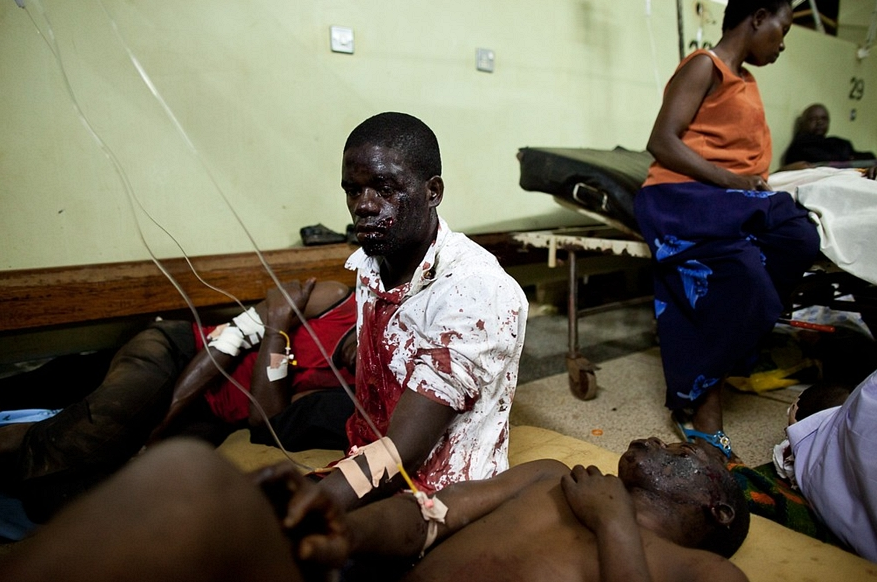
Ugandans were left in shock the evening of March 30, 2015, when Senior Principal State Attorney Joan Kagezi was shot dead in Kiwatule, a Kampala city suburb, while driving home from work with her children in the car. Kagezi was leading the prosecution against the perpetrators of the al-Shabab twin bombings, which took place in July 2010 during the World Cup finals, killing 74 people and injuring another 70. Kagezi was supposed to lead a witness in a testimony about how the explosives were assembled and brought to Kampala.
The news first broke on social media, where discussions about the shooting are using the hashtag #KiwatuleShooting. Raymond Qatahar, an investigative journalist, confirmed the identity of the deceased after he broke the news on Twitter:
New details coming in are that the woman shot was a prosecutor in the terror suspects case that's due to resume tommorow at the high court.
— Qatahar Raymond (@qataharraymond) March 30, 2015
BREAKING: Eye witness says there was a shooting in Najjera Kiwatule. A woman in a car was shot at point-blank range
— Qatahar Raymond (@qataharraymond) March 30, 2015
Eye Witness account: “Two men riding on a boda-boda pulled up to her car and one shot her over four times at point blank range”
— Qatahar Raymond (@qataharraymond) March 30, 2015
Concerned citizens immediately started to demand answers from the authorities:
Why a high profile profile State Attorney was travelling with no security at all is also disturbing.#KiwatuleShooting
— BUTTERFLY (@BeingEdna) March 31, 2015
Qwenga, a Ugandan blogger, pointed out what he sees as a flaw in the country's national security infrastructure:
The problem is; Uganda's Security Personnel think that Terror Alerts are all about bomb blasts. #KiwatuleShooting
— Qwenga (@bkyeyune) March 31, 2015
Angelo Izama, Ugandan writer and blogger, wrote:
My analysis was that if public confidence is withdrawn from the institutions referee-ing conflict, justice wld go into the black market
— Angelo Izama (@Opiaiya) March 30, 2015
Where the rules of protection are different depending on one’s status in society- impunity will rise #Kiwatuleshooting
— Angelo Izama (@Opiaiya) March 30, 2015
Benjamin Rukwengye, another Twitter user, worried that too much was being made of a high-profile individual, while larger numbers of fatalities go unnoticed by the public:
Poorer pple die in tens, like that. We use them as stats&don't ask the hard questions. Reflections maybe? 2/2 @ssojo81@Kalinaki@Natabaalo
— Benjamin Rukwengye (@BibiRukwengye) March 31, 2015
On Facebook, Nicholas Opio, a Ugandan lawyer who worked with Kagezi grieved:
I worked with her in the Kwoyelo trials. I have traveled the world with her for meetings. Rest in Peace Joan. This act of cowardice and criminality has no place in our society. These cowards must be sought after, arrested and should be held to account and must face the full extent of the law.
Richard Anguria Omongole worried that police investigations might not produce any results:
Terrible terrible what act of cowardice. My worry,like many cases before,the police will find nothing and begin looking at family wrangles. That's what makes all of us unsafe. RIP Joan
Am extremely saddened by the news of the gruesome murder of my colleague in the legal profession, JOAN KAGEZI, a Senior Principal State Attorney. My heart goes out to the traumatised children, who were at the scene of this heinous crime in Kiwatule. May her soul rest in eternal peace
Meanwhile, Ugandan Police Chief General Kale Kayihura issued a statement on Facebook:
This evening, Monday 30th March 2015, Ms. Joan Kagezi, Ag. Assistant Director of Public Prosecution, was shot dead at 7:15 pm, near her residence in Kiwatule a city suburb as she drove home with her children.
She had stopped at a fruit stall by the road side where she normally stopped to purchase fruits, when the criminals riding on a motorcycle of boxer type, red in color, stopped next to the parked vehicle and shot her twice in the neck and shoulder, through the widow on the driver’s side. She was driving the vehicle herself.
The Director of CIID, Assistant Inspector General of Police Grace Akullo who by coincidence was driving some distance behind her, was the first police officer on the scene.
She coordinated the evacuation of the deceased to Mulago hospital where she was pronounced dead on arrival. Her three children who were with her escaped unhurt.
Ms. Joan Kagezi was in charge of the International Crime Division handling international crimes such as terrorism, war crimes, and trafficking in persons.
At the time of her tragic death she was the lead prosecutor in the case of the 2010 terror suspects now before the High Court.
She was, also working with the Police in the prosecution of the suspects in the recent spate of murders, robberies and terrorism in Busoga region and Kampala. Her death is a big loss to the country.
Nashville's prosecutors were treating suspects like insects. (Photo by IAEA Imagebank)
By Michael Arria
Nashville’s district attorney recently banned his staff from using invasive surgery as a bargaining chip, after it became apparent that local attorneys had been using sterilization as part of plea bargains.
In the most recent case, a woman with a long history of mental illness was charged with neglect after her young baby died. Jasmine Randers, 26, suffers from paranoia and had fled from a Minnesota treatment facility where she was under state commitment. The district attorney refused to go forward with a plea unless she agreed to be sterilized.
The cause of Randers’ baby’s death could not be determined. A cab driver who drove her to a hotel the night before she brought the baby to a hospital claims the baby was screaming, but stopped completely during the ride. Prosecutors speculated that the child could have suffocated in Randers’ coat during the cab ride, died as a result of unexplained infant death syndrome, or been accidentally crushed to death by Randers while she slept. According to an investigation by the Tennessean, the child was healthy and there were no signs of traumatic injury.
[...]
The case was picked up by the assistant district attorney Brian Holmgren
and assistant public defender Mary Kathryn Harcombe. Holmgren wouldn’t
accept a plea deal unless Randers had her tubes tied. Harcombe viewed
the stipulation as coercive, so she went over his head to Davidson
County district attorney Glenn Funk and explained the situation. Funk
has now cracked down on the practice, saying, “I have let my office know
that that is not an appropriate condition of a plea. It is now policy
that sterilization will never be a condition of deal-making in the
district attorney's office."
By DANIEL W. STAPLES
Police fabricated evidence to pin a woman's 1994 murder on her innocent boyfriend, the man claims in Federal Court, exonerated after 19 years in prison.
Sabein Burgess says Maryland vacated his wrongful conviction on Feb. 21, 2014, after the Mid-Atlantic Innocence Project helped him reveal that prosecutors relied on fabricated gun-shot residue evidence.
"Mr. Burgess spent nearly two decades in prison for a murder he did not commit," the March 23 complaint states. "Worse yet, he was convicted of killing a woman he loved."
His attorney, Gail Horn of Loevy & Loevy in Chicago, noted in an interview that "no amount of money will give him back that two decades of his life, but hopefully this lawsuit will give him some justice and true ability to rebuild the life he has now."
Now 44 years old, Burgess spent 19 years in prison for the Oct. 5, 1994, murder in Baltimore of his then-girlfriend, Michelle Dyson.
Burgess said he had just stepped out after Dyson put her four children to bed that night when "two men pushed their way into" the house, brought Dyson down to the basement and shot her.
Police allegedly set their sights on Burgess from the get-go, swabbing his hands at the scene and taking him immediately to the station for interrogation.
Burgess says "no evidence implicating him" in the crime, however, and that he was released from police custody the next morning.
Rather than search for the real killers, Burgess says the police conspired with crime lab employee Daniel Van Gelder over the next month to fabricate gun-shot residue, or GSR, evidence against Burgess.
By Tom Boggioni
The lead prosecutor in a case that sent an innocent Louisiana man to death row for 30 years, penned a heartfelt apology to the man admitting, “I was not as interested in justice as I was in winning.”
In the letter, published by the Shreveport Times, attorney A.M. Stroud III claimed responsibility for the conviction of Glenn Ford in the 1983 murder of Isadore Rozeman, a Shreveport jeweler.
“I was at the trial of Glenn Ford from beginning to end. I witnessed the imposition of the death sentence upon him. I believed that justice was done,” Stroud wrote. “I had done my job. I was one of the prosecutors and I was proud of what I had done.”
Ford, now 64, was released from Louisiana’snotorious Angola prison on Tuesday by a Shreveport judge after Louisiana state prosecutors stated they could no longer stand by his conviction.
Ford was sentenced to death by an all-white jury and convicted despite the testimony of a primary witness who admitted in court that she lied to protect her boyfriend who was also a suspect.
Stroud wrote his letter in support of Ford, who is seeking to be compensated by the state for the time spent while wrongly incarcerated.
“Glenn Ford should be completely compensated to every extent possible because of the flaws of a system that effectively destroyed his life,” Stroud wrote. “The audacity of the state’s effort to deny Mr. Ford any compensation for the horrors he suffered in the name of Louisiana justice is appalling.”
According to Stroud, he was only interested in winning the case, writing, “In 1984, I was 33 years old. I was arrogant, judgmental, narcissistic and very full of myself. I was not as interested in justice as I was in winning. To borrow a phrase from Al Pacino in the movie And Justice for All, ‘Winning became everything.'"
Jabbar Collins at the law firm where he now works. (Photo by Andrew Burton)
By Joaquin Sapien, ProPublica
New York City has agreed to pay $10 million to settle a wrongful conviction lawsuit filed by Jabbar Collins, who spent 15 years in prison for a murder he did not commit.
The settlement announced today concludes a decades-long struggle for Collins, now 42.
He was just 22 when he was sent to Green Haven Correctional Facility in upstate New York for the 1994 murder of Brooklyn landlord Abraham Pollack. In the years that followed, Collins turned his cell into a full-fledged jailhouse lawyer's office. He filed Freedom of Information Requests, re-interviewed witnesses, and taught himself to write and submit legal motions. Eventually, he gained the attention of a Manhattan defense attorney named Joel Rudin, who helped Collins win his freedom by persuading Federal Judge Dora Irizarry to vacate his conviction in 2010.
As ProPublica has reported, the effort by Rudin and Collins, in many ways, helped trigger the downfall of former Brooklyn District Attorney Charles "Joe" Hynes, whose top aide Michael Vecchione prosecuted Collins. In their lawsuit, Collins and Rudin accused Vecchione of violating several bedrock legal principles in order to win the conviction, saying he coerced witnesses, withheld exculpatory evidence, and suborned perjury. To bolster their claim, Collins and Rudin pointed to other instances of similar abuses by Brooklyn prosecutors, suggesting thatwhat Vecchione did was part of a larger, systemic pattern of misconduct that Hynes either overlooked or encouraged during his 23 years in office.
In an interview, Rudin said that the settlement marked a very gratifying moment for himself and Collins.
"I worked for four years to get him out of prison and another four years to get him some compensation and some sort of vindication," Rudin said.
Rudin also represented Collins in his lawsuit against the state of New York, which settled last month for $3 million. The total of $13 million Collins will receive is among the largest settlements New York has agreed to pay anyone wrongfully convicted in the state.
"I had three goals when I brought this lawsuit," Collins said in a press statement issued today. "One was to expose the illegal practices of District Attorney Hynes and to help drive him from office. The second was to obtain personal vindication and to demonstrate my innocence. The third was to receive compensation that would recognize the enormity of the harm that was done to me and my family and would provide financial security for the rest of my life. I accepted the City's offer because it meant that I had achieved all of my goals."
Collins' victory comes on the heels of several other settlements for high-profile wrongful convictions in New York. Earlier this year, David Ranta was awarded $6.4 million after spending 23 years in prison for a murder he always swore he did not commit. In June, five men wrongly convicted in the infamous Central Park jogger case were awarded $1 million each for every year they spent in prison.
A spokesperson for the New York Law Department issued a brief statement about Collins' settlement, pointing out that when Collins' conviction was first overturned in 2010, the Brooklyn District Attorney's office conceded that exculpatory evidence was withheld.
"We believe this settlement is fair and is in New York City's best interests," the statement said.
Last year, Hynes lost his bid for a seventh term as Brooklyn District Attorney after coming under heavy criticism for his handling of wrongful convictions. He is now being investigated by the New York Department of Investigation over allegations that he received advice from a top Brooklyn judge on several sensitive matters, including media coverage of Collins' case.
A spokesperson for Kenneth Thompson, who has since taken over the District Attorney's office declined to comment for this story.
By CN
A former El Paso County, Texas assistant district attorney was sentenced Thursday to 33 months in federal prison for accepting bribes to drop criminal cases.
U.S. District Judge Kathleen Cardone also fined former prosecutor Antonio Reyes $500.
Reyes accepted cash bribes in exchange for filing and supporting motions to dismiss in criminal cases pending against unidentified third parties, the November 2013 indictment states.
The Indictment of Antonio Reyes
The indictment can be found below: Click the arrow (<) on the left side to view the document without thumbnails.
A Case of Fake Terrorism in America?: 94 Percent of the 400 "terrorism" cases reviewed did not involve terrorism at all.
Attorney Kathey Manley. (Screen captured from YouTube video)
"We went through all the cases and we looked for the signs of "preemptive prosecution" (defendants are targeted for their beliefs, no real crime is committed, a sting operation). In a total of 74 percent of the 400 cases were what we would call pure preemptive prosecutions... Another 20 percent of those cases had elements of preemptive prosecutions where there was some crime going on (fraud, Internet crime, drug crimes) but not terrorist related crimes. But because the people were Muslim, and whatever other reasons the government was suspicious of their beliefs, they enhanced their sentences, they tried to inject elements of terrorism into these cases. So we call those cases elements of preemptive prosecutions. And if you add those in to the pure preemptive prosecution cases it adds up a total of 94 percent. Of the cases they [the U.S. government] claim are terrorists aren't really terrorists at all... Only 13 out of the whole list of 400." —Kathy Manley
JAMES CORBETT of the Corbett Report interviews Kathy Manley of Project SALAM and the National Coalition to Protect Civil Freedoms about her recent study, “Inventing Terrorists: The Lawfare of Preemptive Prosecution.”
Below: The study, Inventing Terrorists: The Lawfare of Preemptive Prosecution followed by a compilation of some of the "synthetic" terrorism cases of the FBI and other U.S. law enforcement agencies, The FBI's Synthetic Terrorism During Contemporary Times.
Inventing Terrorists: The Lawfare of Preemptive Prosecution Click the arrow (<) on the left side to view the document without thumbnails.
________________
The FBI's Synthetic Terrorism During Contemporary Times
Click the arrow (<) on the left side to view the document without thumbnails.
By Sidney Powell
As Attorney General Eric Holder prepares to enter the penultimate year of his tenure leading the Department of Justice, the time to honor his sweeping promise to “clean up” the Department of Justice is rapidly diminishing. For many, the time can’t pass quickly enough—and be sure he will stay until the bitter end. Awaiting his departure from the Department is a subpoena from Congress that he would no longer be able to avoid.
Not only has Mr. Holder failed to make any of the reforms he promised in the wake of his forced dismissal of the indictment against former Senator Ted Stevens, the changes he has made have been for the worse. Absent a dramatic about-face, Holder will leave the Department of Justice littered with corrupted prosecutions and prosecutors, his own contempt of Congress, numerous Supreme Court reversals, and scathing rebukes from federal judges.
In 1990, Jonathan Fleming was convicted of a murder that took place in Brooklyn,
New York. These documents suggest he was in Florida at the time, supporting his
original alibi. But the prosecutor who handled the case never shared the information.
Evidence of a convicted murderer’s possible innocence sat buried in a
case file for more than two decades. Now, a prosecutor in Brooklyn will
have to answer for the mistake.
By Joaquin Sapien ProPublica
Update 06/10/2014 11:54 a.m.: As of last week, James Leeper was no longer employed by the Brooklyn District Attorney’s office. A spokeswoman for the office would not provide further comment as to why his employment ceased after 27 years of service. He’d previously been suspended after he missed a critical proceeding in a May murder trial due to his drinking.
On the afternoon of July 18, 1990, James Leeper, a newly minted homicide prosecutor in Brooklyn, had to make a challenging closing argument. The man he had charged with murder had mounted a substantial defense—offering plane tickets and video footage indicating he had been vacationing at Disney World when a man named Darryl Rush was shot dead in front of a Brooklyn housing project. Leeper acknowledged to the jury that it seemed like the "perfect alibi."
Nonetheless, Leeper confronted the defense straight on: Yes, the defendant, a man named Jonathan Fleming, could have been in Florida around the time of the murder, Leeper conceded to the jury. But Fleming had ample opportunity to fly back to New York, kill Rush and return to his family vacation, Leeper argued. In fact, Leeper told the jury, there were 53 possible airline flights Fleming could have taken to do just that.
Leeper's presentation won the day. The jury returned a guilty verdict. Fleming, 27, was sentenced to 25 years to life in prison.
It took 24 years, but eventually it became clear that there had been much more to Fleming's alibi defense, and that Leeper had failed to disclose it to the jury.
In the late eighties, James Leeper was a fast-rising prosecutor known
for his fairness and loyalty. Decades later, his alleged misconduct in
Fleming's case has shocked colleagues and adversaries alike.
The original case file from 1990 contained a time-stamped receipt showing that Fleming had paid an Orlando hotel phone bill just hours before Rush's murder. The file also contained a letter from the Orlando Police Department informing Brooklyn detectives that Fleming had been seen at the hotel around the time of the killing. By law, Leeper was obligated to turn that material over to Fleming's lawyer. But he had disclosed none of it.
In April, Fleming was set free, the latest victim of a string of wrongful convictions involving the Brooklyn District Attorney's office. But Leeper's role in the case has packed a distinctive mix of shock and dismay.
Interviews with an array of current and former Brooklyn prosecutors, his adversaries in the defense bar, and at least one former Brooklyn judge have uniformly produced glowing testimonials to Leeper's skill, compassion and integrity. People, even those with unflattering views of Leeper's longtime boss, former District Attorney Charles J. Hynes, and the office he ran, find it close to impossible to accept the fact that Leeper knowingly hid vital evidence in a murder case.
"He was universally thought of as a model prosecutor," said Dan Saunders, now a Queens Deputy Executive Assistant District Attorney, who once worked with Leeper in the Brooklyn District Attorney's office. "You'll hear that from everybody. He was a trustworthy and reliable guy. The kind of guy you want to entrust with the difficult work of being a government prosecutor. I hope people say something like that about me one day."
To date, the district attorney's office has said nothing about the Fleming case, other than to acknowledge that its Conviction Integrity Unit had discovered the receipt and additional evidence in recent months. The office offered no explanation for how or why the evidence had remained buried for so long, and, with respect to Leeper's role in the case, has said only that it is "under review."
ProPublica spent several weeks exploring Leeper's career as a prosecutor in Brooklyn, and found an amalgam of genuine respect and personal troubles. Interviews with several current and former colleagues detail his quick, initial rise in the office, but also a long-standing struggle with alcohol. Those interviews with people who worked with Leeper show that eventually his drinking earned him a demotion two years ago.
This receipt from a Quality Inn in Orlando,
Florida, was taken from
Jonathan Fleming
at the time of his arrest. It suggests he was
thousands
of miles away from a murder he
was convicted of, just hours before it
occurred.
ProPublica's review also shows that Leeper's career included a 1997 case in which he and the Brooklyn District Attorney's office were accused of withholding evidence that might have established the innocence of a convicted murderer.
Leeper, in a telephone interview, refused to comment. He did not respond to further requests to discuss the Fleming case, his career or any issues with alcohol.
The reputation of prosecutors in Brooklyn has been battered in recent years.
Earlier this week the New York City Department of Investigation issued a scathing report finding that Hynes, among other violations, received political advice from a top New York state judge and misused public money to fund his ultimately failed 2013 re-election campaign. In a lawsuit, he's also been accused of having long overseen an office of rogue prosecutors, where misconduct was condoned, even encouraged. Hynes has denied the charges in the lawsuit.
One of Hynes's top lieutenants, Michael Vecchione, has been accused of railroading an innocent man on a murder charge, a claim he has vehemently denied. Another senior prosecutor left the office in 2012 after she was accused of having withheld exculpatory evidence in a high-profile rape case that soon was abandoned. Some 90 murder convictions involving the office are under review, many involving a retired police detective, any one of which might hold additional trouble for current or former prosecutors.
For all the accusations and embarrassments, however, few in the New York legal world would have predicted Leeper would be at the center of the latest tumult.
Until last month, Leeper still had a portfolio of cases he was prosecuting. On May 5, he was due in court to make another closing argument in a murder case. The family of 23-year-old Nikita Grebelskiy, a passenger in a livery cab who was shot in the head during a botched robbery, was awaiting justice. Leeper had already laid out all the evidence against 21-year-old Michael Magnan. When he was arrested the night of the crime, Magnan had a .380 caliber shell casing in his shoe, the casing matched the bullet lodged in Grebelskiy's head, a gun found near the crime scene matched both the bullet and the casing, and there was DNA found on the gun that matched the shooter.
All that was left for Leeper to do was sum it all up in one final statement to the jury. But he didn't show up.
He was nearly 40 miles away, in a hospital, recovering from a damaging bout with alcohol, according to numerous current and former colleagues.
"I've never heard of anything like this happening before," said Martin Goldberg, Magnan's defense attorney, who has worked on New York criminal cases for more than 30 years.
Jonathan Fleming, hugs one of his attorneys, Taylor Koss, in Brooklyn's
Supreme court, after a
judge declared him a free man. (Screen capture from YouTube video)
Three weeks ago, the Brooklyn District Attorney's office, now run by former federal prosecutor Kenneth Thompson, announced that Leeper had been suspended. The office did not say why, and refused to answer any questions about Leeper's career or his role in any possible misconduct.
Taylor Koss, a former Brooklyn prosecutor who spent years working alongside Leeper, has said Fleming intends to sue—both to learn the truth of what happened and to be compensated for the loss of more than two decades of his life.
"This man suffered behind bars for 25 years because this information wasn't turned over," Koss said.
A Pupil Becomes a Foil
Taylor Koss joined the Brooklyn District attorney's office in September 2001. He was a young, ambitious lawyer, eager to realize his long-held dream of being a top prosecutor, one that he said harkened back to his teen-age days watching hours of Law & Order on television.
James Leeper was one of Koss's early bosses and mentors. At the time, Leeper was running one of the most active bureaus in the office. Prosecutors in it handled nearly all criminal prosecutions in some of the most violent areas of Brooklyn, and the unit was known officially as the "Red Zone." Koss said he wanted to shine there, and saw in Leeper a man to impress and to learn from.
"He had a reputation for being a very strong homicide prosecutor, that he earned it, as opposed to others who were thought of as being political appointees," Koss said of Leeper. "People respected Jim for being a workhorse who earned his spot."
Leeper himself had already been in the Brooklyn office for 14 years. He, like Koss, had his heart set on being a prosecutor in his first years out of law school. So much so that he applied twice, enduring a rejection by the Brooklyn office's top brass in 1985, according to the office's personnel records.
"An [assistant district attorney] plays two vital roles in society," Leeper wrote as part of his second, successful application. "The position requires one to be an advocate within the criminal justice system as well as a neutral and objective representative of the people in the district in which he or she works."
"In the latter role, one has the responsibility to thoroughly investigate all 'leads' in a case and to approach cases with a non-advocacy, or non-adversary, perspective. In that sense, one of the A.D.A's most important duties is to ensure that a defendant's constitutional rights are preserved and protected."
The letter moved the district attorney's office, then run by former U.S. Representative Elizabeth Holtzman, to hire Leeper away from private practice. By 1990, with Hynes having succeeded Holtzman, Leeper had secured a position as a homicide trial attorney, an impressively advanced assignment for a young man with only three years of experience as a prosecutor.
By the time Koss was christened as a fledgling prosecutor in 2001, Leeper was head of the Red Zone, and "everyone," according to Koss, "wanted to work in the Red Zone."
"It had the coolest people in it. The coolest bosses," said Koss. "It was the place to be and I got it. I got lucky."
Koss reported to Leeper for more than a decade, and he, like so many others who worked under Leeper, revered the man for his fairness and loyalty. Leeper stuck up for younger prosecutors when they made missteps; he took them aside to school them in the art of persuading a jury; he gave them opportunities to challenge themselves.
"He had implicit faith in me, and if you earned that trust, he'd never micromanage," Koss said. "He believed I could handle myself. He only came to see me do one trial. I had a cooperating witness and he came to watch me put him on, and after that he never questioned me again. I wanted him to trust me because I wanted to be in his good graces. People wanted him to think you were a good D.A."
But those who worked with Leeper came to see a troubled side of him, too. In interviews, more than half a dozen lawyers who worked in the office at the time said Leeper's drinking became pronounced, and, as a result, a problem. Two years ago, according to numerous people in the office, Leeper's drinking cost him his title. Personnel records show he was demoted from chief of the Red Zone back to the homicide bureau, but do not list a reason.
The district attorney's office would not comment on the cause for the demotion.
For his part, Koss moved on to his own new job within the office: deputy bureau chief of the Conviction Integrity Unit, a small group of assistant district attorneys and investigators tasked with re-examining old convictions that might have been flawed.
Koss, in his new job, soon found himself in the uncomfortable and unpopular position of reviewing cases handled by prosecutors who had made their marks years before. He says, however, that he came to feel a sense of gratification in the work: finding evidence that might lead to an innocent person's release, rather than a guilty person's incarceration.
Koss's first case wound up widely celebrated. Over a year-long investigation, Koss and his supervisor, John O'Mara, found evidence that an unemployed printer had been wrongly convicted of murdering a beloved Williamsburg rabbi in 1990. Hynes consented to the release of David Ranta following Koss' investigation in March 2013.
"I'm sure people resented me for it, but I didn't really care," Koss said of the unit's work.
In June 2013, three months after Ranta's release, Koss left the office. But he said he had made a critical observation in his last year there, one that would stay with him in the coming months: Murder cases, especially those tried in Brooklyn in the early, bloody 1990s, could be seriously flawed, and so could the prosecutors who handled them.
Newly in private practice, Koss came to learn of an imprisoned man named Jonathan Fleming, and shortly afterward he joined Fleming's bid for freedom. Fleming's case was pending before the Conviction Integrity Unit Koss once helped run, and Koss realized quickly what lay ahead: He'd be challenging the work and perhaps the ethics of his onetime mentor.
The Alibi Defense
Jonathan Fleming didn't have an unblemished record or reputation in Brooklyn in the late 1980s, having racked up a number of convictions, including for robbery and weapons possession.
But the evidence that Fleming was the man who had gunned down Darryl Rush back in 1989, even at the time of the trial, was less than overwhelming.
One witness, a crack addict, had testified that she had seen Fleming shoot Rush. But it was ultimately shown that she had been more than 400 feet from the scene of the shooting and had not been wearing her glasses at the time. Another witness had been so reluctant to testify that he had to be dragged to the witness stand by a court officer.
As a result, Fleming had spent years after his conviction pressing for a re-examination of his case. The crack addict had recanted shortly after the trial. The man who had reluctantly testified turned out to have testified under a false name. New witnesses had emerged saying that another man was the likely shooter.
Fleming's efforts, however, got nowhere. Prosecutors dismissed the recantation and the reliability of the new witnesses. Judges routinely denied his motions for a rehearing.
Then, in the summer of 2013, with the Brooklyn District Attorney's office under fire for a variety of alleged misconduct, Koss's former colleagues agreed to look into Fleming's claims of innocence.
The ex-colleagues unearthed a bombshell: The Fleming case file had been found, and its contents crippled the case against him. There was, among other evidence, the receipt that had been taken off of Fleming's person at the time of his arrest, and it showed he had paid a phone bill at his hotel in Orlando at 9:27pm on Aug. 14, 1989. The murder took place in the Williamsburg section of Brooklyn at approximately 2:15 a.m.
Koss recalled the moment he got word of the discovery made by his old office.
"I was instantaneously nauseous; physically sick to my stomach," he said.
"You want to believe that these mistakes don't happen," he said. "Then, slowly, you come to the realization that these mistakes do happen, and it results in people losing years of their lives."
Koss credits the work of the Conviction Integrity Unit. But the district attorney's office has said nothing about the botched case, other than to consent in court to Fleming's release.
Had the case file been lost? Overlooked? Buried in a police file not shared with prosecutors? Intentionally withheld by Leeper?
James Devereaux was one of the detectives who worked the Fleming case. At the original trial, Fleming's attorney had asked Devereaux several questions about the phone bill receipt, including whether he recalled telling Fleming he'd make a Xerox copy of it. He testified that he had no recollection of a receipt, but, under questioning, conceded it was possible that one existed and even that he had assured Fleming he would make a copy of it. But the receipt was never entered as evidence in the case.
In an interview with ProPublica, Devereaux said he didn't remember the Fleming case, but he was firm about his evidence disclosure practice at the time.
"I'm not in a position to try to put blame on anybody, especially when I don't recall the case," Devereaux said. "But when a case goes to trial, you go to the D.A.'s office with your file and everything goes over to them."
The law is certainly clear about the responsibility for gathering and disclosing evidence. Leeper was the person ultimately responsible for discovering it and turning it over.
Bennett Gershman, a law professor at Pace University and a leading expert on prosecutorial misconduct, wrote a recent column about the case entitled Don't Let the Prosecutor Off the Hook. In an interview, he said prosecutors will often try to deflect blame for evidence disclosure problems onto police.
"But even if we assume it was in the police file and not the district attorney's file, and the prosecutor had no firsthand knowledge of this thing, once the defense attorney says, 'Hey, check this out, this is a major claim of innocence,' the prosecutor has got an obligation to go back to the police and say, 'Do you have this receipt? Did you write a report? Did you ask the hotel if he was there?'
"It goes to what your obligation is as a prosecutor," Gershman said. "Is it to bury your head in the sand? Or is it to follow all possible leads to find out whether this guy is innocent? This wasn't a needle in a haystack; this was something that was right under his nose."
A Prior Offense?
Anne Feldman served 26 years as a judge in Brooklyn, but across those years, she only once exercised the power to set a convicted prisoner free. The prisoner was Julio Acevedo, and the prosecutor whose failure factored in his release was James Leeper.
In 1989, Feldman had presided over Acevedo's initial murder trial. Acevedo had been charged with fatally shooting a man in a housing project hallway in Brooklyn. At trial, Acevedo had claimed that he'd been caught up in an ugly street beef over drugs and had been forced, with his own life threatened, to carry out the deadly shooting.
Acevedo's argument made an impression on Feldman, but ultimately failed to persuade the jury. At Acevedo's sentencing, Feldman said she had "no idea what the real circumstances were" that led him to kill.
"I suspect the truth lies somewhere between what you said and what the district attorney said," Feldman told Acevedo in court.
She then sent him away for 20 years to life.
But the case was back before Feldman eight years later. Something new had come to light: evidence that Acevedo's account—known legally as a "duress defense"—was genuine. A prosecutor in a subsequent, unrelated case had taken testimony from a man who said he was the person who had forced Acevedo to carry out the killing. The man said he had kidnapped Acevedo and ordered him at gunpoint to fire the deadly shots.
Leeper was the prosecutor who took the potentially exculpatory statement. The information—gained in 1992, three years after Acevedo's conviction and five years before his release—was never turned over to Acevedo. The man's account had surfaced in yet another unrelated Brooklyn case, and Acevedo's lawyers had brought it to the court's attention.
Feldman, presented with the new information, didn't waste much time. Acevedo pleaded guilty to a lesser charge and was released.
"I remember feeling that this guy had told a story at his trial that was true and just feeling very good about letting him out," Feldman said in an interview last month with ProPublica.
It remains unclear to this day what Leeper was thinking. The man who had confessed to forcing Acevedo to kill had also admitted to Leeper a long string of violent crimes. As well, Leeper had not previously prosecuted Acevedo and the circumstances of his conviction might well not have been known to him.
There is no evidence Leeper was in any way sanctioned. Feldman, in releasing Acevedo, appears to have only dealt with the new evidence, and not the question of Leeper's apparent failure. Still, a spokesman for the district attorney's office would years later acknowledge the failure to alert Acevedo to the new evidence was a mistake.
The law, after all, requires that information favorable to the defense be turned over by prosecutors as soon as they discover it, even after someone has been convicted.
Dan Saunders, who was a senior homicide attorney in Brooklyn at the time, declined to comment on this particular case, but in an interview he emphasized the importance of sharing such information no matter the timing.
"Whether a case is pending or the person has already been convicted or served their sentence, if we get something exculpatory, there's always an obligation to investigate it and turn it over," he said.
Feldman said Leeper never struck her as the kind of aggressive prosecutor so driven to win that he might break the rules to do so.
"It seemed to me that he was a very upfront guy," Feldman said. "He was not overly zealous; I didn't feel like he was out to kill like some of the other prosecutors out there."
Uncertain Fate
The April 8, 2014, proceeding before Brooklyn Judge Matthew D'Emic was brief, if momentous.
Brooklyn Assistant District Attorney Mark Hale, in consenting to Jonathan Fleming's release from prison after 24 years, quickly laid out the rationale.
"The documentary evidence, and I'm talking specifically about the receipt from the Florida hotel and the interviews with the employees at the hotel…was not available to the defense at trial," Hale told D'Emic. "We uncovered that in an investigation…And it supports the defendant's alibi to such an extent that had it been available at the trial, the likely result of it would've been different. And for that reason we ask that the conviction be vacated."
D'Emic accepted a motion to dismiss Fleming's conviction, and pandemonium ensued in the courtroom.
Reporters from every major newspaper and television channel in New York were there to record an overjoyed Fleming celebrating with his family. His story went viral. A Wall Street banker started an Internet campaign that raised nearly $50,000 to help Fleming get back on his feet; the donations came from more than 600 people in at least 14 different countries.
But little was said about Leeper. Few news articles even mentioned his name. And he went on prosecuting a full load of cases.
Less than a month ago, at least five of his cases were moving toward trial, according to court records. They included the case against Magnan, the young man arrested with a casing in his shoe that matched a bullet in a murder victim's head, and another, thornier case involving the alleged murder of 50-year-old Robert Reichl.
According to 2013 news accounts, Reichl was lured to the roof of an apartment building in the Sunset Park neighborhood of Brooklyn with the promise of sex for money. Allegedly, a group of men attacked him, stole his money, and pushed him off the roof. Three men have been charged in the crime, but at least two claim they're innocent.
Howard Greenberg, an attorney representing one of the accused, said he'd come to know and respect Leeper over the years. Greenberg said if Leeper is proven to have intentionally withheld evidence in the Fleming case, he will have no sympathy for him. But until then, Greenberg said he was not uncomfortable with Leeper continuing to try cases.
"He's a guy that I like and I have found to be above board," Greenberg said. "But let's put it this way, anyone who knew something like that was there and didn't turn it over is going to hell. I'm not pulling punches."
The lack of sanctions against New York prosecutors shown to have engaged in misconduct has been the focus of a ProPublica investigation for more than a year. The investigation found that such prosecutors almost never endure real punishment for their lapses, even when their misconduct is so egregious that it lands the innocent in prison.
Kenneth Thompson, Brooklyn's new district attorney, had pledged during his 2013 campaign that he would rehabilitate the office's reputation on wrongful convictions. And since taking the helm in January, he seems serious about keeping his word. He's vacated the convictions of six people prosecuted under Hynes and he's named some respected legal minds to establish his own version of the Conviction Integrity Unit. He has hired Ronald Sullivan, a Harvard legal ethics professor, to lead the effort.
But to date, there has been no word on Leeper's fate for his role in the Fleming case, a state of uncertainty that has only added to the confusion among his many admirers.
"I worked with him and for him, and I'd do it again," said one former colleague. "He was intelligent, he understood how to try cases, and he was fair — never a win at all costs kind of guy."
For their part, Fleming's lawyers say Leeper's failure was grossly negligent, and blame for it is shared by everyone involved in the case.
"What I truly believe is that everyone on that side is at fault," said Taylor Koss, the former Brooklyn prosecutor and Leeper protégé. "If they had stood up to their ethical obligations, all of this information would've been sent over and all of this could've been avoided."