Drop Down MenusCSS Drop Down MenuPure CSS Dropdown Menu
Alternative Text Alternative Text Alternative Text Alternative Text
Survivor of US Drone Attack:
Obama Belongs on List of World's Tyrants

Poisoning Black Cities: Corporate Campaign to Ethnically Cleanse US Cities Massive Marches in Poland
Against Authoritarian Threat of Far-Right
Ethiopia’s Invisible Crisis: Land Rights Activists Kidnapped and Tortured

Global Perspectives Now Global Perspectives Now
Showing posts with label minimum wage. Show all posts

Judge Takes Away Minimum Wage Protections From Home Care Workers

Front Line Troops: Sonia & Belen, just two of the army of homecare workers looking after dear old mom... (Photo by Andrew Currie)
Front Line Troops: Sonia & Belen, just two of the army of homecare workers looking
after dear old mom...  (Photo by Andrew Currie)
By Bryce Covert
On Monday, U.S. District Judge Richard Leon struck down a rule change issued by the Department of Labor that would have extended minimum wage and overtime pay protections to home care workers come January.

In 1974, the Fair Labor Standards Act (FLSA) — the law requires American employers to pay their workers at least the minimum wage and extra pay for overtime hours — was expanded to cover domestic workers. Yet a carve-out was included for those who provide “care and fellowship” to the elderly and disabled in their homes. That exemption became so broadly interpreted as to deny basic labor rights from those who feed, clothe, and bathe clients, as well as give them medical care. In 2007, under that law, the Supreme Court ruled that a woman named Evelyn Coke’s employer, who had her work long hours giving care, did nothing illegal by failing to give her overtime pay.

Judge Leon’s decision said that the rule change issued last year conflicted with this 40-year exemption. He wrote that this loophole “is not an open question” that the Labor Department can “effectively rewrite…out of the law,” calling the change a “thinly-veiled effort to do through regulation what could not be done through legislation.”

Under his ruling, home care workers who are employed by agencies and other third-party employers can still be denied the minimum wage and overtime pay if they provide primarily “fellowship and protection” rather than more in-depth care. Workers who are employed by agencies and live in their clients’ homes can also be denied overtime.

The decision sides with Home Care Associates, the International Franchise Association, and the National Association for Home Care & Hospice, which sued the Department of Labor, saying

Read More

Why Republicans Hate Obama's Immigration Plan: Immigrants Will Get Working Papers — And Will Have to be Paid a Fair Wage

Photo by ep_jhu.
Photo by ep_jhu.
By Damian Paletta
President Barack Obama ’s move to potentially offer legal-worker status to several million undocumented immigrants will send unpredictable ripples through the U.S. economy, prompting many to seek higher paying jobs and heightening wage competition in a number of sectors, economist say.

Those studying the potential impact of the president’s executive order, which he’s expected to announce Thursday night, point to the Reagan-era 1986 Immigration Reform and Control Act, which allowed around 1.7 million undocumented immigrants to become lawful permanent residents and around 1 million farmworkers to apply for a higher level of legal status.

The 1986 law had an almost immediate labor-market impact, according to government research as well as studies conducted by a number of economists, sociologists, and demographers.

Federal data showed that immigrants in farming and sales jobs were the most likely to move to higher-paying work in different industries.

Read More

Under-the-Table, Off-the-Books Work: The Scary Economic Trend Making Americans More Job-Insecure Than Ever


By Lynn Stuart Parramore
They’re stuck in pieced-together part-time gigs and often getting paid off-the-books. Too discouraged to look for regular jobs, these are the inhabitants of what trendwatchers are calling the “gray economy.” In California alone, their numbers, which include many freelance workers, are 6.2 million, or over 16 percent of residents.

Like a dismal cloud spreading over the sky to blot out the sun, the gray economy is trapping millions of Americans in a dark world of haphazard and insecure jobs, few or no benefits, nonexistent chances for advancement, and little recourse if they get screwed.

As Tiffany Hsu explained in a recent LA Times report, measuring the extent of this economic netherworld is challenging:

“It's hard to track the growth of the gray economy because so many employers hide workers for tax purposes. Experts generally agree, however, that the ranks of the underemployed swelled during the recession — more than in past downturns — and have remained substantial in an unsteady recovery.”

Some experts fear this is more than a cyclical change, it's evidence of a more fundamental shift toward job insecurity. This shift appears to be driven by a myriad of trends and policies, from globalization to outsourcing to shareholder value ideology which focuses corporate attention to short-term profits and stock market manipulation. These factors, plus the decimations of unions and the giant Wall Street-driven economic shocks which create high unemployment, have shifted power away from workers and toward employers who seek their short-term advantage no matter what the social and economic costs. Starting in the '70s, the lifetime career at one company gradually shifted to a less secure full-time job, then work as an independent contractor, and now, finally, to under-the-table work.

Read More


Mexico’s Minimum Wage is Criminally Low: As Low as $5 for an 8-Hour Workday in Some Regions — Is It Constitutional?

A few of the items in an average family's food basket.  Photo courtesy of Juan Tadeo.
A few of the items in an average family's food basket.  Photo courtesy of Juan Tadeo.

By J. Tadeo, Translated by Victoria Robertson
In Mexico, the working minimum wage varies geographically. In regions designated “A” (like Mexico City and various towns in the border states of Baja California, Nuevo León, and Sonora), people earn 67.29 pesos (about $5 USD) for an 8-hour workday.

How many workers in Mexico must subsist on this kind of pay? Journalist Juan Pablo Becerra Acosta has the answer:
It's more than a few. According to the most recent data compiled by INEGI [the National Institute of Statistics and Geography], 6.7 million Mexicans earn minimum wage. This represents 15.1% of those employed in the country.
This statistic, incidentally, does not include people whose pay is off the books.

According to Article 123 of Mexico's Constitution, the country's minimum wage should be sufficient to provide the head of a household with the means to satisfy the family's material, social, and cultural needs and to ensure that any children receive an education.

In reality, however, what minimum wage salary afford Mexico's workers on a daily basis?
It turns out that 67.29 pesos is not enough to buy a single kilogram of average quality beef, the price of which is about 80 pesos (or $6 USD). On the other hand, the wage is enough to buy a kilo of tortillas, a kilo of eggs, and a liter of pasteurized milk—all of which are considered basic food items in the Mexican diet. With a somewhat happy belly, however, there is little money left over for other basic necessities, like transportation.

A one-way ticket on the Metro, one of the principal modes of transportation in the Mexican capital, runs 5 pesos. That means people in Mexico City spend at least 10 pesos a day—almost 15 percent of the minimum wage income—getting to and from work. In other words, after a full day of working for minimum wage, the average Mexican would not be able to buy a hamburger, french fries, and a beverage combo, the cost of which is closer to 70 pesos ($5.26 USD).

Fast food court in Mexico. Photo by Juan Tadeo, used with permission.

It is interesting to compare Mexico's minimum wage with the salaries paid to public sector employees. The average government employee earns 2,018.70 pesos per month (about $151 USD). Employees elsewhere along the public sector ladder, like the department head at the National Cancer Institute, make as much as 28,027.09 pesos per month ($2,107 USD). The country's President, Enrique Peña Nieto, receives 142,117.76 pesos, according to official sources, which works out to $10,685 USD per month.

One Twitter user made the following comparison:
[Caption reads, "$65 pesos for an 8-hour day would be $6 dollars in the U.S. vs $10 dollars for an hour of work would be 125 pesos in Mexico. But when Mexicans complain, they are told to stop being troublemakers and get back to work."]
Mexican Senator Alejandra Barrales of the leftist Party of the Democratic revolution recently shared the following data:
From 2000 to 2011 [during the PAN administrations], Mexico had one of the lowest wage growths of any Latin American country.
Barrales’ remarks responded to claims by the opposing National Action Party (PAN), which has positioned itself as a defender of Mexico's downtrodden workers. Commenting on the PAN's proposition to review wage rates, Twitter user Fher Garcia writes:
If members of the PAN really want to do something about the minimum wage, they should probably start by trying to live off it themselves.
If we consider what a person's salary ought to cover, based on the letter of the law, and contrast that with what a day's minimum-wage earnings actually buy, it raises serious concerns about how Mexico's current minimum wage fuels the profound class divisions that plague Mexican society today, perhaps violating the country's Constitution.


Reprinted with permission from Global Voices.


Trying to Be Slick, A Minnesota Restaurant Places Cost of Minimum Wage Increase On Customer Checks — And Faces Backlash

Oasis Cafe on Facebook
By Ashley Lutz
A Minnesota restaurant has started charging a fee to offset a minimum wage hike.

The Oasis cafe in Stillwater is charging customers an extra 35 cents, reports CBS Minnesota.


Minnesota recently raised the minimum wage for tipped employees. Oasis told CBS that the change would cost the restaurant about $10,000 a year.

Patrons of the restaurant are complaining on its Facebook page.

"If you cannot afford to pay your employees, maybe you cannot afford to run a restaurant," one man who identified himself as a former customer said.

Numerous people called for a boycott.

Read More

Image of Pop Star Purchased by PR Hired Gun and Used to Advocate Against Wage Increases — No Miley Cyrus is Not Against the Minimum Wage


By Mary Bottari and Sean Hoey
On an almost daily basis, Miley Cyrus can be seen in grocery store lines on the cover of entertainment magazines and gossip rags. But now Cyrus is appearing in one place you might not have expected – on a billboard in Los Angeles denouncing higher wages.

The Employment Policies Institute (EPI), whose president is Richard Berman, the infamous PR flak dubbed "Dr. Evil" by 60 Minutes, reportedly purchased the image of Cyrus for a billboard attacking California's $9 minimum wage. Apparently, Berman's clients think that nine bucks an hour is just too much money for folks in Los Angeles, where the cost of living is skyrocketing.

The 72-year-old Berman may not know what twerking means, but he certainly knows how to exploit young people to advance his corporate agenda. Through the years, Berman has launched PR campaigns to convince people that smoking bans are bad, fast food is good, and tanning beds pose no risk of cancer.

Now, through his phony EPI think tank, he is working to convince America that a fair minimum wage will harm teens and the economy, when the opposite is true.

Phony Think Tank Attacks "Raise the Wage" Campaigns

In recent months, the 501 (c)(3) tax exempt Employment Policies Institute (not to be confused with the Economic Policy Institute, a legitimate think tank packed with economists and PhDs) appears to have become supercharged, writing opeds in newspapers across the country and spending big bucks on high-dollar PR tactics, such as full page New York Times ads and TV commercials that warn America of the dangers of higher wages (not to mention the invasion of "commie" economists who back them).

The fact is that EPI doesn't know what it is talking about. A growing body of evidence, including a study of wage hikes during recent high periods of unemployment, shows that minimum wage increases do not cause job loss or slow rehiring. But that doesn't stop newspaper editors from accepting Berman's spin.

A recent review by CMD showed that only 3 percent of the time did newspapers correctly identify EPI as tied to Berman & Co. It isn't hard. As a front page New York Times story pointed out earlier this year, EPI shares an address with Berman & Co. and the PR firm "bills" the tax-exempt nonprofit for services, making it a highly questionable money making venture.

Even $2.13 Is Too Much for Berman

Not only is Berman's EPI fighting against rate hikes for general hourly employees, but it also fights tooth and nail against any effort to raise the wage for tipped workers. For 22 years, the federal tipped minimum wage has been stuck at $2.13 an hour, and the gap between the minimum wage and the tipped minimum has never been higher. While Berman likes to portray restaurant workers as young teens, the facts are that two-thirds of food workers are over 21 and 66 percent are women, many of whom are mothers. Some 3.3 million workers get this "subminimum" wage, and many need to rely on foodstamps and other public services to make ends meet. At the same time, restaurant industry profits and CEO pay are soaring, documents the Institute for Policy Studies.

Recently, Berman's EPI ran a wraparound ad in the Washington Post promoting another one of its proliferating websites, Tipped Wage. The ad shows a well-dressed white guy being erased and pleads, "Don't erase my job -- or my tips," as if tips would disappear if workers are given an increase in their $2.13 salary. In the ad, EPI claims to cite the "best economic research," which purports to show that restaurant employment will "dramatically" fall if wages rise. In fact, the best economic research shows that the states with the highest tipped wage have a booming restaurant sector and that raising the wage floor helps workers at the bottom as well as at the top of the wage scale.

But Berman's PR campaigns aren't limited to the economics. He seeks to distort the images of the groups fighting to raise wages.

One of the websites tied to Berman by an electronic "paper trail" is ROCexposed.org, dedicated to tearing down the New York-based non-profit Restaurant Opportunities Center. Founded in memory of the restaurant workers who died on 9-11, ROC advocates for higher wages and fair treatment for restaurant workers. As CMD reported, Berman appears to have tag-teamed with an old client and tipped-wage foe: the National Restaurant Association. Dubbed the "Other NRA", the behemoth food industry lobby shop has apparently earmarked more than $600,000 to attack the Restaurant Opportunities Center and lists ROCexposed.org as a key ally in those efforts. Similarly, Berman's attack website Activistcash.org spins tall tales about his critics, including the Center for Media and Democracy.

Berman's Anti-Environment Front Group Compares Obama to a Terrorist

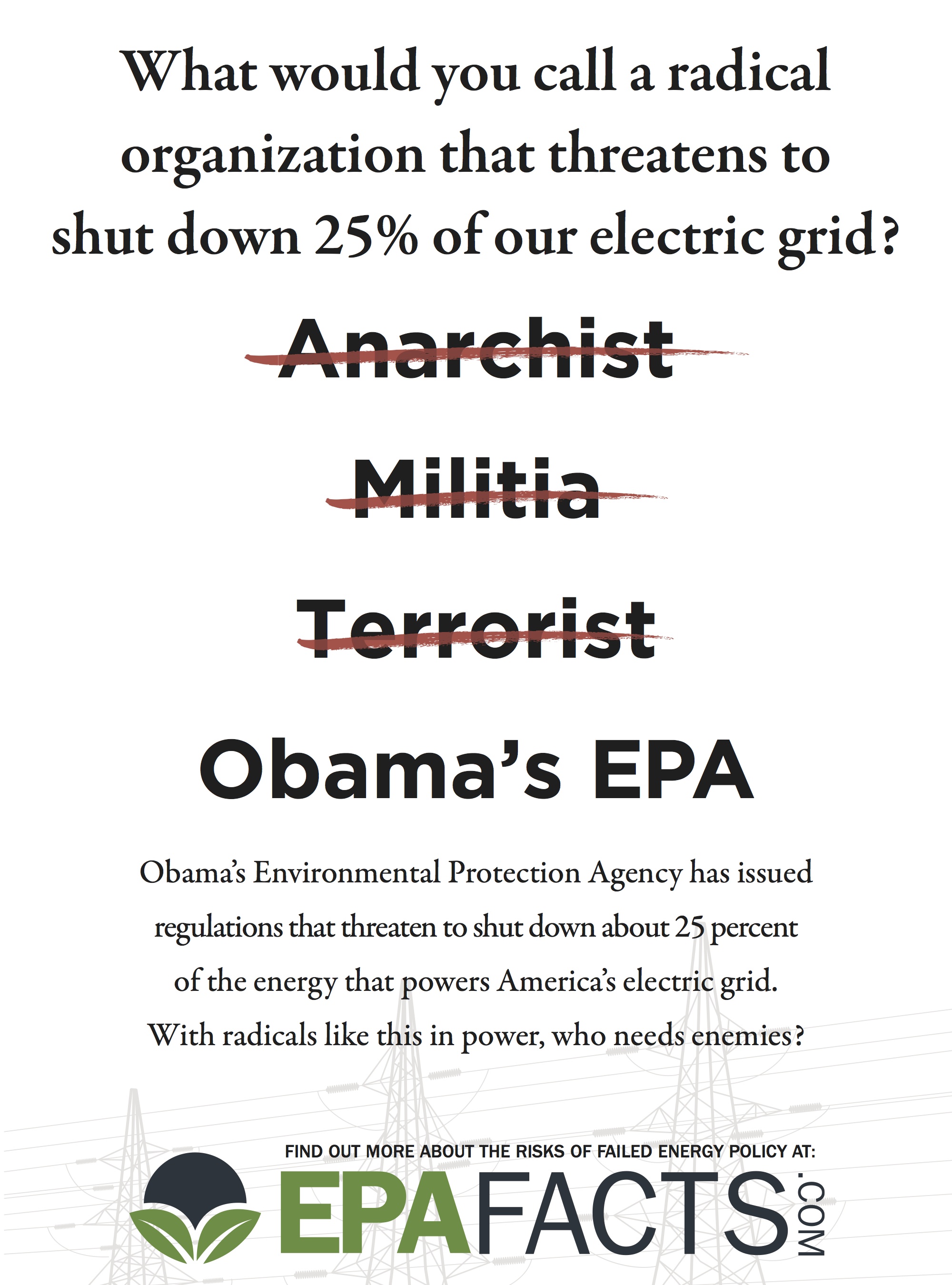
Another of Berman's most recent PR campaigns involves the Environmental Policy Alliance (EPA), a front group created in the spring of 2014. "EPA" sounds like a ringing endorsement for all things green, and it uses a symbol that looks a heck of a lot like the symbol used by the actual EPA, but a closer look reveals an agenda that only the fossil fuel industry would love.

In June 2014, as a response to the Obama administration's announcement of new federal rules that will dramatically slash emissions from existing power plants, Berman's EPA Facts unleashed a full-page ad in both Politico and USA Today condemning the move as a radical threat to the country's energy resources. The ad compared the administration to a terrorist organization and trumpeted unsubstantiated claims that the rules threatened "to shut down about 25 percent of the energy that powers America's electric grid."

Berman's "EPA" frontgroup operates a number of websites, including Big Green Radicals, EPA Facts, Green Decoys, and LEED Exposed, each taking on a different issue within the environmental movement. Big Green Radicals spends a lot of time attempting to tear down groups like the Sierra Club and Food and Water Watch, an effective DC-based consumer group that fights to protect water and campaigns against fracking. FWW views the Berman attacks as a badge of honor and uses them to raise funds for their campaigns, not the result Berman would hope for.
Berman Group Alleges Animal Rights Group Abuses Animals

Berman is also fond of attacking people seeking to protect animals; he does this via his Center for Consumer Freedom (CCF) front group.

In July 2014, CCF relaunched the attack site PETA Kills Animals. The site berates PETA for "dirty tactics," features graphic images of dead dogs, and calls for PETA to be "put down." Berman clients may be upset about PETA's effective campaigns against abusive factory farming practices that underpin cheap eats and the fast food industry. It should come as no surprise that sick and abused animals that are brought to PETA shelters often have to be euthanized. PETA discloses its data on these cases, and then Berman exploits those records to tarnish the organization.

In May 2014, another CCF website, Humane Watch, launched new ads, including one in USA Today charging the Humane Society of the United States with being corrupt and mismanaged. HSUS spokesperson Alan Heymann speculated that industry interests, like factory farms and puppy mills, are fearful of HSUS's work and were fueling the attacks to discredit the organization. He added that if Berman and his front groups really cared about animal welfare, they would choose to invest directly in other animal rights groups rather than slandering a reputable charity.

According to a report in LA Weekly, the use of Cyrus' image could land the Berman team in hot water: "Most celebrities are very litigious, and if [Cyrus] doesn't stand behind it they could end up being in a legal mess," said Steven M. Weinberg, an intellectual property and branding attorney. "It's okay to use something in an informational, First Amendment way, but if you look like she's endorsing it you could run into problems. If, in fact, this is not her position, then it may transcend First Amendment protection."

If Cyrus doesn't take action, next we will hear that she was spotted with President Obama shooting cats and dogs at an HSUS fundraiser. Nothing seems beneath the Berman spin machine.

Check out the Center for Media and Democracy's profiles of Berman front groups and attack websites in our SourceWatch wiki:

Reprinted with permission from PRWatch.

Industry Group's Lawsuit Seeks To Kill Seattle’s Minimum Wage: Claims It Violates Their Free Speech — Hey, It Worked With Campaign Spending

Rally To Raise The Minimum Wage in New York City, October 2013. (Photo by The All-Nite Images)
Rally To Raise The Minimum Wage in New York City, October 2013. (Photo
by The All-Nite Images)
By Ian Millhiser
Last week, Seattle Mayor Ed Murray (D) signed a bill that will eventually raise his city’s minimum wage to $15 an hour. It took eight days for a lobbying group representing major employers like McDonald’s and Taco Bell to file a lawsuit asking the courts to repeal the legislation.

In a sensible world, this lawsuit would have no chance of prevailing. Many of its claims are frivolous — and comically so. The lobbying group argues, for example, that Seattle’s new minimum wage violates the First Amendment because “by increasing the labor costs of franchisees, the Ordinance will reduce the ability of franchisees to dedicate funding to the promotion of their businesses and brands.” In other words, the law requires businesses to spend money paying workers a living wage that they could otherwise spend on advertising, and this somehow violates the Constitution’s guarantee of free speech. If this were actually what the Constitution required, then any law imposing costs on anyone would be unconstitutional, including all taxes. After all, every dollar paid in taxes is a dollar that can’t be spent to buy an ad promoting the deliciousness of the Big Mac.

Read More


Minimum Wage Levels in US Slammed by—of ALL Organizations—The International Monetary Fund

Rally to raise the Minnesota minimum wage in St. Paul, Minnesota - Feb 25, 2014.
(Photo by Fibonacci Blue)
The US, which prides itself as being a great economy with a "great big middle class" (ha-ha) ranks 11th among members of the Organization for Economic Cooperation and Development (OECD).


By Annie-Rose Strasser
The United States is facing new international pressure to raise its minimum wage. In its annual review of the U.S. economy released on Monday, the International Monetary Fund criticized America for wages that are both historically low and lower than other countries, and it called on the U.S. to raise its wages accordingly.

Addressing the U.S.’s persistently high poverty rates, the report lauds the U.S.’s expansion of health care coverage thanks to the Affordable Care Act, then argues for two separate policy fixes to further aid in the reduction of poverty: expanding the Earned Income Tax Credit (EITC) to cover more low-income people and raising the minimum wage.

“An expansion of the Earned Income Tax Credit—to apply to households without children, to older workers, and to low income youth—would be [an] effective tool to raise living standards for the very poor,” the report states. “Similarly, the government should make permanent the various extensions of the EITC and the improvements in the Child Tax Credit that are due to expire in 2017.

“[G]iven its current low level (compared both to U.S. history and international standards), the minimum wage should be increased,” it goes on. “This would help raise incomes for millions of working poor and would have strong complementarities with the suggested improvements in the EITC, working in tandem to ensure a meaningful increase in after-tax earnings for the nation’s poorest households.”

The U.S. ranks 11th of OECD countries in minimum wage, when measured as a percentage of median income.

Read More

Over One-Fourth of Men 25-34 Years-Old Earned Poverty-Level Wages in 2013


By Elise Gould, Economic Policy Institute
In honor of Father’s Day, we looked at the wages of male workers at the prime age for raising young children. While women have always been more likely to earn poverty-level wages than men (wages less than what a full-time, year-round worker needs to sustain a family of four at the official poverty threshold), women have seen some improvement over the last three-and-a-half decades, as their rates of poverty-level wages have declined, especially among those 35 to 44 years old.
On the other hand, men between 25 and 44 have seen precipitous increases in the share working at such low wages, with the share more than doubling between 1979 and 2013. This trend has been particularly stark among the younger age group. The figure below shows the share of male and female workers between 25 and 34 and between 35 and 44 years old who earn poverty-level wages. In 2013, that hourly wage was $11.49. Over one-fourth of men 25-34 years old earned poverty-level wages in 2013.

The bottom line is there are a great many adults, and an increasing share of men, stuck in very low-paying jobs, and they are the same people who are responsible for raising the next generation.

Three New Ways the Koch Brothers Are Screwing America: Suppressing Wages, Breaking Unions, Disenfranchising Minority Voters

Occupy Wall Street, Day 9 - Sept 25 2011: NYC
Occupy Wall Street, Day 9 - Sept 25 2011: NYC (Photo by David Shankbone)
The fourth-richest men in America target low-wage workers, minority voters and unions.

By
"They are truly cowards in the worst way," says filmmaker Robert Greenwald, of the notorious billionaires Charles and David Koch. And he should know. After he released his 2012 documentary, "The Koch Brothers Exposed," Koch-funded organizations took out ads trying to discredit Greenwald and his work, yet the brothers still declined his repeated offers to debate the topics covered in the film, like the re-segregation of schools and the defanging of the EPA. "I wanted to engage in a policy debate," he says. "But they won't engage."

For most people, an attack from the fourth-richest (and perhaps most politically conniving) men in America would slow them down. But instead Greenwald, who became interested in the powerful duo when he read Jane Mayer's 2010 New Yorker profile, decided to double down, and began work on "The Koch Brothers Exposed: 2014 Edition." The update, which is now available free online, is centered on their influence in (and outpouring of money since) the Citizens United Supreme Court decision. While researching and producing it with his small staff at Brave New Films, Greenwald says he was "surprised by not just the sheer numbers, but the extraordinary lengths they go to legally to hide the amounts they're giving."

Read More

New York Times Writes Unions Out of the Story on Fighting Poverty — Even Though They Had Information Suggesting Otherwise

The New York Times' source said that the decline of labor unions was  an important cause of inequality–but the Times didn't think that was fit  to print.
The New York Times' source said that the decline of labor unions was
an important cause of inequality–but the Times didn't think that was fit
to print. (cc photo: Kheel Center)
By
The New York Times (6/4/14) took a look at one of the economic puzzles of the last few decades: If growth has been strong, why aren't we seeing a greater reduction in poverty? Interestingly, the research the Times is relying on offers some explanations–ones the paper doesn't see fit to mention.

The story by Neil Irwin–"Growth Has Been Good for Decades. So Why Hasn’t Poverty Declined?"–notes that it's considered conventional wisdom that the "surest way to fight poverty is to achieve stronger economic growth." But since the mid-'70s, the US economy has grown, but the benefits of that growth have not been shared. He writes: "The mystery of why–and how to change that–is one of the most fundamental challenges in the nation's fight against poverty."

The piece is based on research from the left-leaning Economic Policy Institute. As Irwin sums it up:
If the old relationship between growth and poverty had held up, the EPI researchers find, the poverty rate in the United States would have fallen to zero by 1986 and stayed there ever since.
So what has happened to explain this? Irwin gives only a hint, writing that "liberal-leaning group’s policy prescriptions are open to debate." Click on the EPI link in the Times piece, though, and you'll see the researchers offer some pretty clear ideas about why they think this has happened:
Direct evidence highlights the key roles of the two most-visible and well-documented changes in labor market policy and practice over the past generation in driving wage trends: the erosion of the inflation-adjusted value of the federal minimum wage and the sharp decline in the share of the American workforce represented by a union.
Most specifically, EPI notes:
  • Between the 1970s and the late 2000s, the eroded minimum wage explains roughly two-thirds of the growing wage gap between low- and middle-wage workers, and weakened unions explain a fifth to a third of the entire rise of wage inequality.
The point of the piece is to think about what happened from the late 1970s onward. And Irwin does a good job of explaining how Paul Ryan-esque rhetoric about the need to get poor people to work misses the point, since "the reality is that low-income workers are putting in more hours on the job than they did a generation ago–and the financial rewards for doing so just haven’t increased."

So why didn't Irwin talk about the minimum wage or unions–the factors EPI singles out as being especially important to understanding this story?

This piece appeared in the print edition of the Times, but it's part of The Upshot, part of  a new breed of data-rich,  "explain-the-news" sites.  In this case, there does seem to be an explanation for the story it's trying to tell. And for some reason, the Times doesn't want to talk about it.


Reprinted with permission from Fairness & Accuracy In Reporting.

The United States and Other Western Nations Are Lying About the So-Called 'Upturn' in the Economy and Employment: Here Are the Facts — Video

The So-Called Decrease in Unemployment and
Increase in Income is a Myth

Labor force participation rate, personal income and corporate profits
Screen captures from YouTube video.
Top Chart: When the number of people in the workforce is compared with the total number of working age adults (labor force participation rate), the number of people actually working continues to plummet — and reached an all-time record low in 2013.

Bottom Chart: Corporate profits as a share of national income have reached their highest levels since 1950, but the employee share of corporate profits declined to its lowest level since 1966.

Only Thing 'Thriving' in Western Economies is
the Weapons and Spying Industries


The National Restaurant Association Spends Big to Keep Wages Low

Photo by Poiseon Bild.
By Brendan Fischer and Mary Bottari
A majority of the Senate voted to raise the minimum wage to $10.10 per hour recently, yet the bill failed to clear the 60 vote hurdle necessary for passage -- thanks in no small part to the political power of the National Restaurant Association, the restaurant industry's trade association.

For years, the "Other NRA" has flexed its political muscle to keep wages low and to freeze the tipped minimum wage at just $2.13 per hour. Plus, thanks to non-stop NRA lobbying, the House last month passed a bill changing the threshold for employer-provided coverage under the Affordable Care Act to deny healthcare to employees who work 30 hours per week.


This is thanks in no small part to the Other NRA’s super-sized political giving. According to an analysis by the Restaurant Opportunities Center United (ROCUnited), the $683 billion industry's trade association itself has poured $12.6 million directly into federal politicians' campaign coffers since 1989. NRA member organizations have chipped-in around $51 million more: McDonald's, for example, has given $5.8 million to federal politicians, Darden (parent company of Olive Garden, Red Lobster, and Capitol Grille) $5.6 million, and Wendy's $2.3 million. The biggest spender is NRA member Walt Disney; the creator of Mickey Mouse and Donald Duck disclosed $14.1 million in contributions since 1989.

The NRA has also spent millions on the state level. It has worked with the American Legislative Exchange Council (ALEC) to quash local efforts to enact paid sick leave ordinances -- in Oklahoma, for example, the state NRA affiliate worked with Governor Mary Fallin (an ALEC alum) to crush both paid sick leave ordinances and minimum wage ordinances in one fell swoop.

Notably, as the restaurant industry pours tens of millions into politics and fights to keep wages low, it has seen five solid years of record-breaking profits and growth: the industry is expected to increase its profits by $24 billion in 2014, and hit $683 billion in sales.
Super-Sized Political Giving

For decades, the NRA's political spending has bought it mountains of influence.

In the 1990s, it served up enough campaign contributions to persuade Congress to set the minimum wage for tipped workers at just $2.13 an hour. This archaic provision means that big restaurant chains have managed to shift responsibility for paying their workers onto us, the consumers.

That's not the only avenue through which the NRA's political spending leads to a public dunning. Thanks to an abysmally low minimum wage for tipped workers at restaurants like Olive Garden and non-tipped workers at McDonald's and Wendy's, nearly 60 percent of the $600 billion restaurant industry's employees are low-wage workers -- meaning they are twice as likely to be on public assistance as the rest of the population. The National Employment Law Project estimates that the public assistance provided to fast-food workers costs taxpayers at least $3.8 billion a year. Taxpayers fund McDonald’s employees to the tune of $1.2 billion a year in public assistance. The majority of restaurant workers are adult women, many with kids to support.

While moms and kids are struggling, restaurant CEOs are enjoying eye-popping salaries subsidized by the taxpayers. According to a report from the Institute for Policy Studies, big restaurants have exploited a tax loophole to write off more than $200 million in executive “performance pay” over just the past two years. In other words, we as consumers are not only stuck with paying restaurant workers' wages, but we as taxpayers are stuck subsidizing the industry's profits with public assistance programs for their underpaid employees and corporate welfare for their overpaid CEOs.

A Side of Revolving-Door Lobbying and a Dash of Front Groups

The NRA's political giving is served with a side of influence-peddling. Between 2008 and 2013, the NRA more than doubled its count of registered lobbyists, from 15 to 37. At least 27 of the NRA's lobbyists have come through the "revolving door," meaning they jumped from Congressional jobs to lobbying gigs, and then play off their contacts inside the government to advance the restaurant industry's interests. What's more, the NRA's top member companies -- Darden, YUM! Brands (parent of Taco Bell, KFC, and Pizza Hut), Walt Disney, McDonald’s, Marriott, Sodexo, Aramark, Starbucks, and Coca-Cola -- added another 127 registered lobbyists last year. That’s a lot of lobbying power.

In addition to its own paid lobbyists, the industry employs a crew of surrogates to do its dirty work in the public sphere. Salon just reported that the NRA is meticulously tracking the activities of fast food worker advocates and worker advocacy organizations. Salon reports that the Other NRA approved an “additional” $600K to attack ROCUnited. The Other NRA also appears to back groups like ROCexposed.org (a front group linked to notorious astroturf flak Richard Berman), as well as prominent economists like Douglas Holtz-Eakin who push anti-minimum wage rhetoric.

Another example of restaurant industry astroturf is the Employment Policies Institute, which poses as a "think tank" and commissions reports and runs ads and op-eds opposing minimum wage hikes. But EPI is run out of the offices of Berman & Co., Berman’s PR firm, which represents the restaurant industry -- although over 80 percent of journalists fail to disclose those ties. Other Berman projects also advance the restaurant industry's agenda: front groups like the "Center for Consumer Freedom" have fought for years against indoor smoking bans and nutrition labeling requirements, which the industry has long opposed.

NRA "Made a Huge Difference" In Blocking State Minimum Wage Increases

And that's just on the federal level. The NRA and its state chapters have given millions more to state and local candidates, and spent countless millions more on state-level lobbying. And in recent years, the NRA has been at the forefront of the push back against state and municipal efforts to enact their own minimum wage increases and paid sick day requirements.

Last June, the NRA boasted that its state chapters "made a huge difference" and "played an active role" in blocking higher wage laws in over a dozen states. And, it has been the biggest opponent of paid sick day laws in states across the country -- it has even pushed a bill at ALEC to prohibit local governments from requiring employers provide paid sick days to their workers, which has since spread across the country.

Most recently, the Oklahoma NRA affiliate helped push SB 1023 to crush local efforts to guarantee a fair wage and paid sick days in that state; it was signed into law in April by Governor Mary Fallin, an ALEC alumni who gave the keynote at ALEC’s spring meeting last year.

Despite broad popular support for an increase in the minimum wage among both Democrats and Republicans, the Other NRA has managed to stick a fork in the measure in the U.S. Senate for now. Stay tuned, however. Advocates are planning more street heat this summer and during the fall election cycle to convince Congress that America needs a raise.


Tell Congress you can't stomach what the National Restaurant Association is dishing out. Click here to take action!


Reprinted with permission from PRWatch.

337 Workers Fainted at Garment Factories in Cambodia Last Week — Nationwide Strike Was Violently Put Down in January

Workers were sent to a clinic after fainting in a garment factory. Photo from Facebook page of Community Legal  Education Center
Workers were sent to a clinic after fainting in a garment factory. Photo from Facebook page of Community Legal
Education Center.

By Mong Palatino
Three days of mass fainting were reported in garment factories in Cambodia in the first week of April. In the country’s capital Phnom Penh, 337 workers, mostly female, were sent for treatment to four separate clinics.

Over the week, the fainting occurred at 11 buildings in three factories inside Vantanak Park - Shenzhou, Daqian Textile and New Wide. These names are not known outside Cambodia but they produce clothing for international sports brands Adidas, Puma, and Nike.

The garment sector is a $5 billion dollar export industry in Cambodia which employs more than 600,000 workers. For many years, workers have been complaining of receiving measly wages.

Labor groups initially suspected that “unsanitary water and food, and strong fabric odors” caused the fainting among workers.Mass fainting cases have been regularly reported and are blamed on poor working conditions inside the factories.

Last December, garment workers asked the government to raise the monthly minimum wage from $80 to $160 dollars. But the government said the economy can only sustain an incremental $15-$20 increase. In response, garment unions conducted a nationwide strike but this was violently dispersed by police forces in January.

The site of the bloody crackdown is only a few meters away from one of the factories where workers fainted en masse this week.


The Community Legal Education Center linked the fainting with malnutrition and poor wages of garment workers. The group urged global brands to improve the conditions of their supply-chain workers:

International brands such as Adidas, Puma and Nike are complicit in this. Whilst their various codes and standards state that wages are essential for meeting the basic needs of employees and reasonable savings and expenditure, their supply-chain workers are not seeing any tangible benefits.

And we call on international brands such as Adidas, Puma and Nike to take concrete measures to address wages that currently do not satisfy basic needs nor provide for a life with human dignity.

The group also advised the government to raise the wages of workers:

We call on the government to return to wage negotiations immediately and end the endemic corruption that businesses now associate with Cambodia.


More than 300 workers fainted at garment factories. Photo from Facebook page of Community Legal Education  Center
More than 300 workers fainted at garment factories. Photo from Facebook page of Community Legal Education
Center.


Reprinted with permission from Global Voices.


8 Things Mainstream Media Doesn't Have the Courage to Tell You: The Rich Are Ripping Off You and America Every Which Way

Three Wise Mountain Monkeys Illustration by Ronald David Jackson
(click to see full size)
Three Wise Mountain Monkeys

Illustration by Ronald David Jackson
Adapted from Moyan Brenn
The following are all relevant, fact-based issues, the "hard news" stories that the media has a responsibility to report. But the business-oriented press generally avoids them.

By Paul Buchheit
1. U.S. Wealth Up $34 Trillion Since Recession. 93% of You Got Almost None of It
2. Eight Rich Americans Made More Than 3.6 Million Minimum Wage Workers
3. News Sources Speak for the 5%
4. TV News Dumbed Down for American Viewers: A recent Survey Showed That...
-- Americans [are] especially uninformed about international public affairs.
-- American respondents also underperformed in relation to domestic-related hard news stories.
-- American television reports much less international news than Finnish, Danish and British television;
-- American television network newscasts also report much less hard news than Finnish and Danish television.
5. News Execs among White Male Boomers Who Owe Trillions to Society'
6. Funding Plummets for Schools and Pensions as Corporations Stop Paying Taxes
Three separate studies have shown that corporations pay less than half of their required state taxes, which are the main source of K-12 educational funding and a significant part of pension funding. Most recently, the report "The Disappearing Corporate Tax Base" found that the percentage of corporate profits paid as state income taxes has dropped from 7 percent in 1980 to about 3 percent today.
7. Companies Based in the U.S. Paying Most of their Taxes Overseas
8. Restaurant Servers Go Without Raise for 30 Years 

Read More
   

Remember Wall Street Said American Workers Were Unproductive?: Labor Productivity Went Up 80% — And ALL The Profits Went To Executives and Stockholders

Wall Street is led by blood sucking parasites. (Photo by dr_relling)
By Pete Dolack
It is not your imagination — you are working harder and earning less. Despite significant productivity gains during the past four decades, wages have remained flat.

This is a global phenomenon, not one specific to any country. It is not a matter of the viciousness of this or that capitalist, nor the policy of this or that government. Rather, widening inequality flows naturally from the ideological construct that now dominates economic thinking. Consider Henry Giroux’s succinct definition of neoliberalism:

“[I]t construes profit-making as the essence of democracy, consuming as the only operable form of citizenship, and an irrational belief in the market to solve all problems and serve as a model for structuring all social relations.”
“Freedom” is reduced to the freedom of industrialists and financiers to extract the maximum possible profit with no regard for any other considerations and, for the rest of us, to choose whatever flavor of soda we wish to drink. Having wrested for themselves a great deal of “freedom,” the world’s capitalists have given themselves salaries, bonuses, stock options and golden parachutes beyond imagination while ever larger numbers of working people find themselves struggling to keep their heads above water.

On the one hand, U.S. chief executive officers earned 354 times more than the average worker in 2013. And even with the bloated pay of top executives and the money siphoned off by financiers, there was still plenty of cash on hand — U.S. publicly traded companies are sitting on a composite hoard of $5 trillion, five times the total during the mid-1990s.

Read More

Apple and Google Are Part of a 'Wage Fixing' Cartel That Conspired to Keep Workers' Wages Low As Possible — Over 1 Million Workers Affected


 “British medieval ordinances of Bristol cobblers in 1364 state, ‘Masters are forbidden to poach workers from other members of the craft.’”  —Orly Lobel, Talent Wants To Be Free

By
Back in January, I wrote about “The Techtopus” — an illegal agreement between seven tech giants, including Apple, Google, and Intel, to suppress wages for tens of thousands of tech employees. The agreement prompted a Department of Justice investigation, resulting in a settlement in which the companies agreed to curb their restricting hiring deals. The same companies were then hit with a civil suit by employees affected by the agreements.

This week, as the final summary judgement for the resulting class action suit looms, and several of the companies mentioned (Intuit, Pixar and Lucasfilm) scramble to settle out of court, Pando has obtained court documents (embedded below) which show shocking evidence of a much larger conspiracy, reaching far beyond Silicon Valley.

Confidential internal Google and Apple memos, buried within piles of court dockets and reviewed by PandoDaily, clearly show that what began as a secret cartel agreement between Apple’s Steve Jobs and Google’s Eric Schmidt to illegally fix the labor market for hi-tech workers, expanded within a few years to include companies ranging from Dell, IBM, eBay and Microsoft, to Comcast, Clear Channel, Dreamworks, and London-based public relations behemoth WPP. All told, the combined workforces of the companies involved totals well over a million employees.

Read More

Rising Inequality: Recovery Driven Almost Entirely by the Rich


Union Membership and Inequality: Workers suckered by propaganda to be anti-union.
As a result, corporations are running over them. (Chart from CTU Economic Bulletin)

By Gaius Publius, Professional Writer and Contributing Editor at AMERICAblog.com
America's income inequality has grown so wide that the current "recovery" is driven primarily by the upper fifth of income earners, as revealed by the latest consumer spending data. Right now, more than 60% of all consumer spending is done by just the top 20% of income earners. And retailers are noticing.

This is the America that's in recovery. Who is part of that 20% with most of the spending money? First, obviously, are the bigs (the Kochs, the Edelsteins, the Rubins and Dimons, the hedge fund kings and queens). The next level down includes their top retainers (those who are paid — or campaign-financed — to serve their financial interests ... people like, well ...). And finally, there's the broad class of well-paid and needed professionals, those who get the real trickle-down, who earn real money when the economy is good. Doctors, lawyers, high-tech pros, engineers, sales types, the people at the airport on a weekday. Everyone with a needed skill who keeps the machine running and whose job can't be outsourced.

Inflation-adjusted incomes below that point have collapsed, or gone flat with barely a hint of recovery. We'll show this data in two ways below. Read on.

Consumer Spending Data Shows Where the Money Is

Much of this is revealed in a study of consumer spending as described in a recent New York Times article. First, the money quote, then more from the article. The quote:
[T]he current recovery has been driven almost entirely by the upper crust [the top 5% of earners], according to [the study's authors] Mr. Fazzari and Mr. Cynamon. Since 2009, the year the recession ended, inflation-adjusted spending by this top echelon has risen 17 percent, compared with just 1 percent among the bottom 95 percent.
More broadly, about 90 percent of the overall increase in inflation-adjusted consumption between 2009 and 2012 was generated by the top 20 percent of households in terms of income, according to the study, which was sponsored by the Institute for New Economic Thinking, a research group in New York.
The study mentioned above is fascinating but technical. Reading the write-up in the Times will get you well started. It puts numbers to an otherwise amorphous entity, "rising income inequality."

Most Consumption Occurs At the Top

The section just quoted covered change in consumption. There's also information about the amount of consumption itself, divided among the various moneyed and un-moneyed classes. Take a look at this chart, especially the three 2012 bottom lines:

From the top part of the graph, we find that the top 5% of income accounts for almost 40% of consumption. That's stunning in itself. From the middle part, we see the top 20% of income now accounts for more than 60% of consumption. And from the bottom, the other 80% of the nation by income — all of the rest of us — account for less than 40% of consumption. And again, as the graphs show, the trend is widening.

The Vast "Shrinking Middle"

All of this means that the buying power of our vast middle class is shrinking, and with it the wealth of the companies that depend on it. The article is filled with examples of higher-end products and retailers doing well, just like the very low end (like Dollar Tree) which serves the near-destitute. Meanwhile retailers in the middle are seeing a ton of trouble — dwindling sales, store closings and plummeting stock prices. A taste from the article:
Investors have taken notice of the shrinking middle. Shares of Sears and J. C. Penney have fallen more than 50 percent since the end of 2009, even as upper-end stores like Nordstrom and bargain-basement chains like Dollar Tree and Family Dollar Stores have more than doubled in value over the same period.
The same trend is true for restaurants, where middle class brands — think Olive Garden and the like — are hurting. At Olive Garden (average bill of about $16 per diner), revenue is falling. At Capital Grille (average bill of about $70 per diner), revenue is up.

Police Open Fire on Striking Garment Workers in Cambodia

Four are confirmed dead and dozens injured after police and military clashed with striking garment workers in the industrial area of Phnom Penh, the capital city of Cambodia.

Tens of thousands of garment workers have been on strike since the last week of December after the government refused the demand of unions to raise the monthly minimum wage to $160. The current minimum wage is only $80 dollars and the labor council is only willing to grant a $15 dollar hike in basic pay. As protests intensified, the government agreed to raise the minimum wage by another $5.


But workers have been firm in asserting their $160 minimum wage demand. The garment sector is a $5 billion dollar export industry in Cambodia which employs more than 600,000 workers. Many of the leading clothing brands in the world get their supply from Cambodia, which has one of the lowest minimum wage rates in the Asia-Pacific.
John Vink reported what he saw on the scene of the clash:
At least 3 people were shot dead and several were severely injured by hundreds of bullets fired by armed forces during a brutal crackdown in the morning of January 3rd on barricades set up by thousands of striking workers on Veng Sren road, in the industrial area of Phnom Penh. Several others were arrested and subsequently tasered, beaten up or beaten unconscious
Very gruesome pics of wounded/dead all over facebook. Looks like civil war instead of quelling .


Tension rose yesterday when police arrested several protesters, including monks and human rights activists. In response, protesters set-up road blockades which the police tried to clear in the morning. Witnesses claimed that police used live ammunition in dispersing the protest.

Garment Workers in Phnom Penh, Cambodia fired upon.
Vannarin Neou @vannarinneou
military police occupy Veng Sreng street. At least four protestors were arrested
and one was seen bleeding


Licadho described the crackdown as the “worst state violence against civilians to hit Cambodia in fifteen years.” The human rights group is demanding that
…security forces must now put an immediate end to the use of live ammunition against civilians and ensure that all those injured are safely transported to hospital without delay
Ou Virak of the Cambodian Center for Human Rights thinks that the police acted violently to protect the interest of big business:
While many of the political demonstrations which have taken place over the last few months have been met with restraint from the security forces, there is an increasingly clear link between the excessive use of force by security forces and the protection of the big business of Cambodia. Of the 25 cases where we noted excessive use of force, 21 were related to strikes by garment workers or protests over land.
Garment Workers in Phnom Penh, Cambodia fired upon.
Kevin Doyle @doyle_kevin
Frontline barricade


Garment Workers in Phnom Penh, Cambodia fired upon.
Sopheak SREY @sopheaksrey
Ekreach Clinic was destroyed by rioters after its rejected to cure some victims
in a clash at Canadia Park, Jan 3.


Workers got the support of the opposition Cambodia National Rescue Party which vowed to raise wages by $160 if it is able to assume power in the country.

The opposition has been holding daily protests at the Phnom Penh Freedom Park to press for the ouster of the incumbent government which has been accused of manipulating this year’s election results. Prime Minister Hun Sen has been in power in the past three decades although his party lost many seats in the recent parliamentary polls. The opposition has boycotted the parliament sessions even though it has 55 seats.

Many workers have joined the opposition rally which could further undermine the Hun Sen administration. Labor unions have vowed to continue the protests until their demand is granted by the government.
Opposition leader Sam Rainsy announced their intention to file charges against the government in relation to the bloody crackdown of the strike:
We will lodge a complaint to the ICC so that those criminals in power who today ordered soldiers to open fire on workers, be prosecuted.
For its part, the government accused the opposition of provoking the violence to get public sympathy.
The strike of garment workers and the opposition rally produced the biggest ever street demonstration in Cambodia in recent decades. After today’s violence, the political crisis in Cambodia is expected to worsen.


Reprinted with permission from Global Voices.

Related Posts Plugin for WordPress, Blogger...